
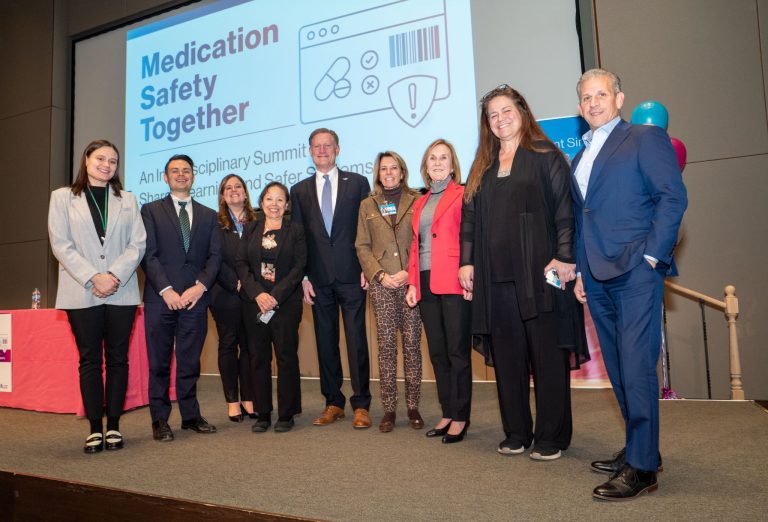
Keynote at Mount Sinai Health System’s Medication Safety Together Summit
November 24, 2025
By ejfadmin
I was truly honored to represent the Emily Jerry Foundation last week at Mount Sinai Health System, where I had the privilege of delivering the keynote address to kick off their Medication Safety Together – An Interdisciplinary Summit… Read More


Illinois Scorecard
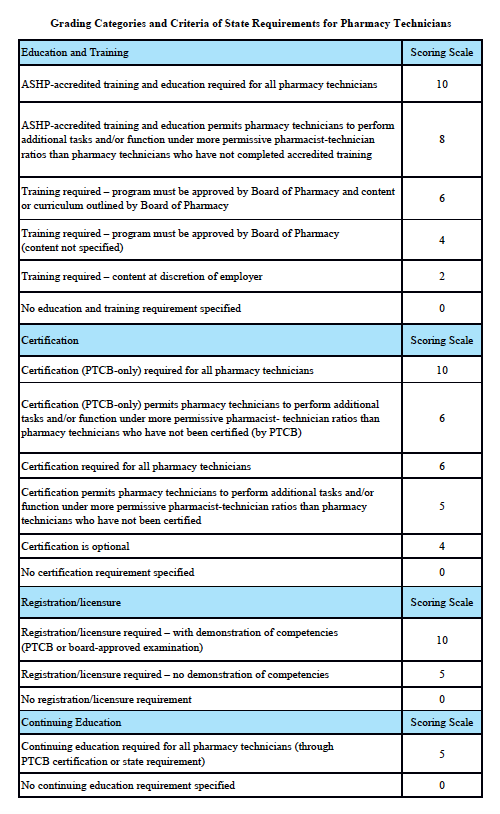
Grading Scale:
A – 85-100%, B – 70-84.9%, C – 55-69.9%, D – 40-54.9%, F – 0-39.9%
Grading Categories & Criteria
Illinois Law
I. Laws
https://ilga.gov/Legislation/ILCS/Articles?ActID=1318&ChapAct=225%26nbsp%3BILCS%26nbsp%3B85%2F&ChapterID=24&ChapterName=PROFESSIONS+AND+OCCUPATIONS&ActName=Pharmacy+Practice+Act%2E
Sec. 9. Licensure as registered pharmacy technician.
(a) Any person shall be entitled to licensure as a registered pharmacy technician who is of the age of 16 or over, has not engaged in conduct or behavior determined to be grounds for discipline under this Act, is attending or has graduated from an accredited high school or comparable school or educational institution or received a State of Illinois High School Diploma, and has filed a written or electronic application for licensure on a form to be prescribed and furnished by the Department for that purpose. The Department shall issue a license as a registered pharmacy technician to any applicant who has qualified as aforesaid, and such license shall be the sole authority required to assist licensed pharmacists in the practice of pharmacy, under the supervision of a licensed pharmacist. A registered pharmacy technician may be delegated to perform any task within the practice of pharmacy if specifically trained for that task, except for patient counseling, drug regimen review, clinical conflict resolution, final prescription verification except where a registered certified pharmacy technician verifies a prescription dispensed by another pharmacy technician using technology-assisted medication verification, or providing patients prophylaxis drugs for human immunodeficiency virus pre-exposure prophylaxis or post-exposure prophylaxis.
(b) Beginning on January 1, 2017, within 2 years after initial licensure as a registered pharmacy technician, the licensee must meet the requirements described in Section 9.5 of this Act and become licensed as a registered certified pharmacy technician. If the licensee has not yet attained the age of 18, then upon the next renewal as a registered pharmacy technician, the licensee must meet the requirements described in Section 9.5 of this Act and become licensed as a registered certified pharmacy technician. This requirement does not apply to pharmacy technicians registered prior to January 1, 2008.
(c) (Blank).
(d) Any person seeking licensure as a pharmacist who has graduated from a pharmacy program outside the United States must register as a pharmacy technician and shall be considered a “”student pharmacist”” and be entitled to use the title “”student pharmacist”” while completing the 1,200 clinical hours of training approved by the Board of Pharmacy described and for no more than 18 months after completion of these hours. These individuals are not required to become registered certified pharmacy technicians while completing their Board approved clinical training, but must become licensed as a pharmacist or become licensed as a registered certified pharmacy technician before the second pharmacy technician license renewal following completion of the Board approved clinical training.
(e) The Department shall not renew the registered pharmacy technician license of any person who has been licensed as a registered pharmacy technician with the designation “”student pharmacist”” who: (1) has dropped out of or been expelled from an ACPE accredited college of pharmacy; (2) has failed to complete his or her 1,200 hours of Board approved clinical training within 24 months; or (3) has failed the pharmacist licensure examination 3 times. The Department shall require these individuals to meet the requirements of and become licensed as a registered certified pharmacy technician.
(f) The Department may take any action set forth in Section 30 of this Act with regard to a license pursuant to this Section.
(g) Any person who is enrolled in a non-traditional Pharm.D. program at an ACPE accredited college of pharmacy and is licensed as a registered pharmacist under the laws of another United States jurisdiction shall be permitted to engage in the program of practice experience required in the academic program by virtue of such license. Such person shall be exempt from the requirement of licensure as a registered pharmacy technician or registered certified pharmacy technician while engaged in the program of practice experience required in the academic program.
An applicant for licensure as a registered pharmacy technician may assist a pharmacist in the practice of pharmacy for a period of up to 60 days prior to the issuance of a license if the applicant has submitted the required fee and an application for licensure to the Department. The applicant shall keep a copy of the submitted application on the premises where the applicant is assisting in the practice of pharmacy. The Department shall forward confirmation of receipt of the application with start and expiration dates of practice pending licensure.
(h) Supportive staff who solely perform clerical work are not required to be licensed as a registered pharmacy technician. It shall be the responsibility of the pharmacy, the pharmacist-in-charge, and the pharmacy technician to ensure supportive staff are properly trained. The pharmacy or pharmacist-in-charge shall alert the Department’s chief pharmacy coordinator when supportive staff have been terminated for threatening patient safety or diversion, in accordance with the requirements of subsection (b) of Section 30.1. As used in this subsection, “”clerical work”” includes, without limitation, operating registers at the point of sale, sorting pre-packaged drugs in pharmacies specializing in centralized prescription filling, and selling prescriptions that have received final verification by a pharmacist in accordance with subsection (c-5) of Section 15.1. “”Clerical work”” does not include data entry, packaging, labeling, or storage.
(Source: P.A. 102-882, eff. 1-1-23; 102-1051, eff. 1-1-23; 102-1100, eff. 1-1-23; 103-154, eff. 6-30-23; 103-240, eff. 1-1-24.)” “Sec. 9.5. Registered certified pharmacy technician.
(a) An individual licensed as a registered pharmacy technician under this Act may be licensed as a registered certified pharmacy technician, if he or she meets all of the following requirements:
(1) He or she has submitted a written application in the form and manner prescribed by the Department.
(2) He or she has attained the age of 18.
(3) He or she is of good moral character, as determined by the Department.
(4) Beginning on January 1, 2024, a new pharmacy technician is required to have (i) graduated from a pharmacy technician training program that meets the requirements set forth in subsection (a) of Section 17.1 of this Act or (ii) obtained documentation from the pharmacist-in-charge of the pharmacy where the applicant is employed verifying that he or she has successfully completed a standardized nationally accredited education and training program, and has successfully completed an objective assessment mechanism prepared in accordance with rules established by the Department.
(5) He or she has successfully passed an examination accredited by the National Commission for Certifying Agencies, as approved and required by the Board or by rule.
(6) He or she has paid the required licensure fees.
(b) No pharmacist whose license has been denied, revoked, suspended, or restricted for disciplinary purposes may be eligible to be registered as a certified pharmacy technician unless authorized by order of the Department as a condition of restoration from revocation, suspension, or restriction.
(c) The Department may, by rule, establish any additional requirements for licensure under this Section.
(d) A person who is not a licensed registered pharmacy technician and meets the requirements of this Section may be licensed as a registered certified pharmacy technician without first being licensed as a registered pharmacy technician.
(e) As a condition for the renewal of a license as a registered certified pharmacy technician, the licensee shall provide evidence to the Department of completion of a total of 20 hours of continuing pharmacy education during the 24 months preceding the expiration date of the certificate as established by rule. One hour of continuing pharmacy education must be in the subject of pharmacy law. One hour of continuing pharmacy education must be in the subject of patient safety. The continuing education shall be approved by the Accreditation Council on Pharmacy Education.
The Department may establish by rule a means for the verification of completion of the continuing education required by this subsection (e). This verification may be accomplished through audits of records maintained by licensees, by requiring the filing of continuing education certificates with the Department or a qualified organization selected by the Department to maintain such records, or by other means established by the Department.
The Department may, by rule, further provide an orderly process for the restoration of a license that has not been renewed due to the failure to meet the continuing pharmacy education requirements of this subsection (e). The Department may waive the requirements of continuing pharmacy education, in whole or in part, in cases of extreme hardship as defined by rule of the Department. The waivers may be granted for not more than one of any 2 consecutive renewal periods.
(Source: P.A. 101-621, eff. 1-1-20; 102-643, eff. 8-27-21; 102-882, eff. 1-1-23.)” “Sec. 17.1. Registered pharmacy technician training.
(a) It shall be the joint responsibility of a pharmacy and its pharmacist in charge to have trained all of its registered pharmacy technicians or obtain proof of prior training in all of the following practice areas as they apply to Illinois law and relate to the specific practice site and job responsibilities:
(1) The duties and responsibilities of the technicians and pharmacists.
(2) Tasks and technical skills, policies, and procedures.
(3) Compounding, packaging, labeling, and storage.
(4) Pharmaceutical and medical terminology.
(5) Record keeping requirements.
(6) The ability to perform and apply arithmetic calculations.
Beginning January 1, 2024, it shall also be the joint responsibility of a pharmacy and its pharmacist in charge to ensure that all new pharmacy technicians are educated and trained using a standard nationally accredited education and training program, such as those accredited by the Accreditation Council for Pharmacy Education (ACPE)/the American Society of Health-System Pharmacists (ASHP), equivalent work experience of 500 hours as a pharmacy technician covering the practice areas set forth in items (1) through (6) of this subsection, or equivalent work experience as a pharmacy technician as set forth by the Department by rule. The pharmacist in charge is not required to provide the required education to the pharmacy technician, but the pharmacist in charge must ensure that the pharmacy technician has presented proof that he or she completed a standard nationally accredited education and training program or has equivalent work experience as provided in this subsection.
(b) Within 2 years of initial licensure as a pharmacy technician and within 6 months before beginning any new duties and responsibilities of a registered pharmacy technician, it shall be the joint responsibility of the pharmacy and the pharmacist in charge to train the registered pharmacy technician or obtain proof of prior training in the areas listed in subsection (a) of this Section as they relate to the practice site or to document that the pharmacy technician is making appropriate progress.
(c) All pharmacies shall maintain an up-to-date training program policies and procedures manual describing the duties and responsibilities of a registered pharmacy technician and registered certified pharmacy technician.
(d) All pharmacies shall create and maintain retrievable records of training or proof of training as required in this Section.
(Source: P.A. 102-643, eff. 8-27-21; 103-68, eff. 6-9-23.)
Illinois Pharmacy Rules
https://www.ilga.gov/agencies/JCAR/Sections?PartID=06801330&TitleDescription=TITLE%2068:%20%
Section 1330.200 Application for Certificate of Registration as a Pharmacy Technician
a) An applicant for registration as a pharmacy technician shall file an application on forms supplied by the Division, together with:
1) A copy of his or her high school diploma or its equivalent, or proof of current enrollment in a high school program; and
2) The fee required by Section 1330.20.
b) Pursuant to Section 9 of the Act, an applicant may assist a registered pharmacist for 60 days upon submission of an application or, submission for reinstatement not due to disciplinary action, to the Division in accordance with subsection (a). A copy of the application must be maintained by the applicant at the site of employment during and until notice of registration or disqualification is received by the applicant and must be readily retrievable for review by the Drug Compliance Investigator.
c) A pharmacy technician must renew his or her registration with the Division on an annual basis.
d) Technician certificate of registration must be displayed and visible to the public in the pharmacy where the pharmacy technician is employed.
e) Every registered pharmacy technician shall notify the Division of any change in the address on record within 30 days after the change.
f) No pharmacist whose license has been denied, revoked, suspended or restricted for disciplinary purposes is eligible to be registered as a pharmacy technician.
g) No person who holds an active Illinois pharmacist’s license may concurrently hold an active Illinois pharmacy technician registration.
h) Any pharmacy technician who is permitted to use the title “”student pharmacist”” pursuant to Section 9 of the Act shall notify the Division within 10 days if he or she has permanently separated from or been expelled from an ACPE accredited college or school of pharmacy; failed to complete his or her 1,200 hours of Board approved clinical training within 24 months; or failed the pharmacist licensure examination 3 times. When this occurs, the technician shall have 90 days to obtain a certified pharmacy technician license as provided in Section 1330.220, unless that certified pharmacy technician was registered prior to January 1, 2008. During the period prior to registering as a pharmacy technician, the individual is not permitted to use the title “”student pharmacist””. If the individual does not become registered as a certified pharmacy technician within 90 days, the pharmacy technician registration shall expire.
(Source: Amended at 39 Ill. Reg. 6267, effective April 23, 2015)” “Section 1330.210 Pharmacy Technician Training
a) It shall be the joint responsibility of a pharmacy and its pharmacist-in-charge to have trained all of its pharmacy technicians or obtain proof of prior training in all of the following topics as they relate to the practice site:
1) The duties and responsibilities of the technicians and pharmacists.
2) Tasks and technical skills, policies and procedures.
3) Compounding, packaging, labeling and storage.
4) Pharmaceutical and medical terminology.
5) Recordkeeping requirements.
6) The ability to perform and apply arithmetic calculations.
b) Within 6 months after initial employment or changing the duties and responsibilities of a pharmacy technician, it shall be the joint responsibility of the pharmacy and the pharmacist-in-charge to train the pharmacy technician or obtain proof of prior training in the areas listed in subsection (a) as they relate to the practice site or to document that the pharmacy technician is making appropriate progress.
c) All pharmacies shall maintain an up to date training program describing the duties and responsibilities of a pharmacy technician.
d) All pharmacies shall create and maintain retrievable records of training or proof of training as required in this Section.
e) Ensuring registered pharmacy technicians and certified pharmacy technicians are properly trained shall be the responsibility of the pharmacy, the pharmacist-in-charge, and the pharmacy technician.
(Source: Amended at 39 Ill. Reg. 6267, effective April 23, 2015)” “Section 1330.220 Application for Certificate of Registration as a Certified Pharmacy Technician
a) An individual may receive certification as a certified pharmacy technician if the individual:
1) Has submitted a written application in the form and manner prescribed;
2) Has attained the age of 18;
3) Is of good moral character, as determined by the Division;
4) Graduated from a pharmacy technician training program approved by the Accreditation Council for Pharmacy Education (ACPE) or the American Society of Health System Pharmacists (ASHP) or obtained documentation from the pharmacist-in-charge of the pharmacy where the applicant is employed verifying that the applicant has successfully completed equivalent work experience of 500 hours as a pharmacy technician covering the practice areas set forth in Sections 17.1(a)(1) through (6) of the Act, or successfully completed work experience as provided for in Section 1330.215;
5) Has successfully passed an examination accredited by the National Commission for Certifying Agencies of the Institute for Credentialing Excellence (NCCA), as approved and required by the Board. The Division, upon the recommendation of the Board, has determined that the Exam for the Certification of Pharmacy Technicians offered by the Institute for the National Healthcareer Association (or its successor), and the Pharmacy Technician Certification Examination offered by the Pharmacy Technician Certification Board (or its successor), are accredited by NCCA and are, therefore, approved examinations for certification; and
6) Has paid the required certification fees.
b) No pharmacist whose license has been denied, revoked, suspended or restricted for disciplinary purposes is eligible to be registered as a certified pharmacy technician. No person who holds an active Illinois pharmacist license may concurrently hold an active Illinois certified pharmacy technician registration.
(Source: Amended at 48 Ill. Reg. 10225, effective June 28, 2024)” “Consider adding:
Section 1330.230 Continuing Education (“CE”) for Certified Pharmacy Technicians
a) CE Requirements
1) Number of Hours of CE Required
A) Each person who applies for renewal of a license as a certified pharmacy technician shall complete 10 hours of CE during the 12 months preceding the expiration date of the license, in accordance with Section 9.5 of the Act.
B) A renewal applicant is not required to comply with CE requirements for the first renewal after original licensure.
2) Required Topics for CE
A) At least one hour of continuing pharmacy education must be on the subject of pharmacy laws, pharmacy rules and ethics;
B) At least one hour of continuing pharmacy education must be on the subject of patient safety; and
C) Any other applicable CE requirements under 68 Ill. Adm. Code 1130.
b) Approved CE
1) The completion of courses offered by providers approved by the Accreditation Council on Pharmacy Education or another standardized nationally approved education program approved by the Department, may be completed outside the State of Illinois are approved CE courses.
2) The pharmacist-in-charge and the certified pharmacy technician must maintain records showing proof of training that constituted the pharmacy technician’s CE.
c) Certification of CE Requirements
1) Each renewal applicant shall certify on the renewal application full compliance with CE requirements set forth in this Part.
2) The Division may require additional evidence demonstrating compliance with the CE requirements (e.g., certificates of attendance, certificates of completion, course registration). It is the responsibility of each renewal applicant to retain or otherwise produce evidence of the compliance. Evidence shall be required in the context of the Division’s random audit in accordance with Section 9.5 of the Act.
d) The same CE hours cannot be used to fulfill the CE requirement for more than one renewal period.
e) Waiver of CE Requirements
1) Any renewal applicant seeking to renew their license without having fully complied with these CE requirements shall file with the Division a renewal application, along with the required fee, a statement setting forth the facts concerning noncompliance and a request for waiver of the CE requirements with facts explaining the basis of the request. A request for waiver shall be made prior to the renewal date. If the Division, upon the written recommendation of the Board, finds from the affidavit or any other evidence submitted that good cause has been shown for granting a waiver, the Division shall waive enforcement of the CE requirements for the renewal period for which the applicant has applied.
2) Good cause shall be defined as an inability to fulfill the CE requirements during the applicable period because of:
A) Full-time service in the armed forces of the United States of America during the applicable period; or
B) Extreme hardship, which shall be determined on an individual basis by the Board and shall be limited to documentation of:
i) An incapacitating illness, documented by a currently licensed physician;
ii) Physical inability to travel to the sites of approved programs, as documented by a currently licensed physician; or
iii) Any other similar extenuating circumstances (e.g., illness of a family member).
3) If a renewal applicant requests an interview before the Board at the time the waiver request is submitted, the Board shall not deny the waiver request before an interview is conducted. The renewal applicant requesting a waiver shall be given at least 20 days written notice of the date, time, and place of the interview by mail or email.
4) Any renewal applicant who submits a request for waiver pursuant to subsection (e)(1) shall be deemed to be in good standing until the final Division decision on the application has been made.
(Source: Added at 47 Ill. Reg. 8352, effective June 2, 2023)”
References
Illinois Pharmacy Act
Illinois Pharmacy Rules
http://www.ilga.gov/commission/jcar/admincode/068/06801330sections.html
The data contained in this 2012 Annual Scorecard are accurate as of December 2012 . Because statutes and regulations are continually revised, the data are subject to change. These data have been verified with the state board of pharmacy. This scorecard is updated on an annual basis in order to incorporate statutory and regulatory changes. A new scorecard will be issued in July 2013.
Scoring rationale for Education and Training:
In order to protect the public and help ensure patient safety, it is important that pharmacy technicians are properly educated and trained. The most rigorous training is accredited training. The sole entity empowered to accredit pharmacy-technician training programs is the American Society of Health-System Pharmacists (ASHP). Please note that this is “programmatic accreditation” – not “institutional accreditation.” It is the content of the training program – as measured against established standards – that is being evaluated and accredited. Accredited training is vital to protecting patient safety because it means that a pharmacy-technician training program has met established quality standards to provide assurance and confidence to the public. For more information, please see http://www.ashp.org/menu/Accreditation/TechnicianAccreditation.aspx.
Scoring rationale for Certification:
Certification is the process by which a nongovernmental agency or association grants recognition to an individual who has met certain predetermined qualifications specified by that agency or association. This is often determined by an examination process. Numerous organizations have recommended that the certification exam conducted by the Pharmacy Technician Certification Board (PTCB) should be recognized as the sole, nationally-accredited certification exam for pharmacy technician certification – including the National Association of Boards of Pharmacy (NABP), the Texas State Board of Pharmacy (TSBP), and the U.S. Department of Veterans Affairs (VA). In a recent report, NABP recommended that states be encouraged to “recognize certification by the Pharmacy Technician Certification Board (PTCB).” Moreover, NABP performed a psychometric audit of the PTCB’s pharmacy technician certification examination (PTCE) in 2001 and determined that the PTCE is psychometrically sound, defensible, and valid. In May 2010, the TSBP awarded the PTCB with the Pharmacy Technician Certification Provider contract in Texas. PTCB was selected for the contract after a rigorous bidding and evaluation process that included formal reviews and evaluations from three independent psychometricians. TSBP confidently recognizes PTCB as the single provider of certification examinations for pharmacy technicians. In addition, in June 2010, the VA began requiring PTCB certification for VA pharmacy technicians employed at grade GS-6 and above.
Scoring rationale for Registration/Licensure:
Registration/licensure is the process by which the state maintains a list of all pharmacy technicians in the state and grants permission for an individual to work as a pharmacy technician in the state based on the applicant’s completion of all pre-requisites to registration/licensure – such as required training and certification.
Scoring rationale for Continuing Education:
Continuing education enables pharmacy technicians to fulfill their professional responsibility to maintain competence and up-to-date knowledge and skills in an environment of technological advances and increasingly complex, new medications and therapies.
Our Mission
The Emily Jerry Foundation is determined to help make our nation’s, world renowned, medical facilities safer for everyone, beginning with our babies and children. We are accomplishing this very important objective by focusing on increasing public awareness of key patient safety related issues and identifying technology and best practices that are proven to minimize the “human error” component of medicine. Through our ongoing efforts The Emily Jerry Foundation is working hard to save lives every day.
Recent Posts
Archives