“Pharmacy Technician” means a person registered with the board to practice certain tasks related to the practice of pharmacist care as permitted by the board.” §30-5-5a. Legislative findings; registration of pharmacy technicians; qualifications; training programs; rules and restrictions. Repealed, now covered under 30-5-11.
§30-5-11. Registration of pharmacy technicians.
(a) To be eligible for registration as a pharmacy technician to assist in the practice of pharmacist care, the applicant shall:
(1) Submit a written application to the board;
(2) Pay the applicable fees;
(3) Have graduated from high school or obtained a Certificate of General Educational Development (GED) or equivalent.
(4) Have:
(A) Graduated from a competency-based pharmacy technician education and training program as approved by legislative rule of the board;
(B) Completed a pharmacy-provided, competency-based education and training program approved by the board; or
(C) Obtained a national certification as a pharmacy technician and have practiced in another jurisdiction for a period of time as determined by the board.
(5) Have successfully passed an examination developed using nationally recognized and validated psychometric and pharmacy practice standards approved by the board;
(6) Not be an alcohol or drug abuser, as these terms are defined in §27-1A-11 of this code: Provided, That an applicant in an active recovery process, which may, in the discretion of the board, be evidenced by participation in a 12-step program or other similar group or process, may be considered;
(7) Not have been convicted of a felony in any jurisdiction within 10 years preceding the date of application for license, which conviction remains unreversed;
(8) Not have been convicted of a misdemeanor or felony in any jurisdiction if the offense for which he or she was convicted bearing a rational nexus to the practice of pharmacist care, which conviction remains unreversed; and
(9) Have fulfilled any other requirement specified by the board in rule.
(b) A person whose license to practice pharmacist care has been denied, revoked, suspended, or restricted for disciplinary purposes in any jurisdiction is not eligible to be registered as a pharmacy technician.
(c) To be eligible to obtain a nuclear pharmacy technician endorsement, the applicant shall:
(1) Submit a written application to the board;
(2) Pay the applicable fees;
(3) Have graduated from high school or obtained a Certificate of General Educational Development (GED) or equivalent;
(4) Have successfully completed a pharmacy provided, competency-based nuclear pharmacy technician education and training program approved by the board;
(5) Have all applicable national certifications and comply with all federal rules and regulations;
(6) Not be an alcohol or drug abuser, as these terms are defined in §27-1A-11 of this code: Provided, That an applicant in an active recovery process, which may, in the discretion of the board, be evidenced by participation in a 12-step program or other similar group or process, may be considered;
(7) Not have been convicted of a felony in any jurisdiction within 10 years preceding the date of application for license, which conviction remains unreversed;
(8) Not have been convicted of a misdemeanor or felony in any jurisdiction if the offense for which he or she was convicted bearing a rational nexus to the practice of pharmacist care, which conviction remains unreversed; and
(9) Has fulfilled any other requirement specified by the board in any rule.
(d) A person whose license to practice pharmacist care has been denied, revoked, suspended, or restricted for disciplinary purposes in any jurisdiction is not eligible to be registered as a nuclear pharmacy technician.
(a) To be eligible for registration as a pharmacy technician trainee to assist in the practice of pharmacist care, the applicant shall:
(1) Submit a written application to the board;
(2) Pay the applicable fees;
(3) (A) Have graduated from a high school or obtained a Certificate of General Educational Development (GED), or
(B) Be currently enrolled in a high school competency based pharmacy technician education and training program;
(4) (A) Be currently enrolled in a competency-based pharmacy technician education and training program of a learning institution or training center approved by the board; or
(B) Be an employee of a pharmacy in an on-the-job competency-based pharmacy technician training program.
(5) Not be an alcohol or drug abuser as these terms are defined in section 11, article one-a, chapter twenty-seven of this code: Provided, That an applicant in an active recovery process, which may, in the discretion of the board, be evidenced by participation in a twelve-step program or other similar group or process, may be considered;
(6) Not have been convicted of a felony in any jurisdiction within ten years preceding the date of application for registration, which conviction remains unreversed;
(7) Not have been convicted of a misdemeanor or felony in any jurisdiction which bears a rational nexus to the practice of pharmacist care, which conviction remains unreversed; and
(8) Have requested and submitted to the board the results of a fingerprint-based state and a national electronic criminal history records check.
(b) The rules, authorized duties and unauthorized prohibitions as set out in section twelve of this article for pharmacy technicians apply to pharmacy technician trainees.
(c) The board shall promulgate an emergency rule and legislative rule pursuant article two, chapter twenty-nine-a, to authorize the requirements of this section to permit pharmacy technician trainees.”
2.2. “Certified Pharmacy Technician” or “CPhT” means a person who holds a current certification as a nationally certified pharmacy technician granted by NHA or PTCB.
2.5. “”Pharmacy Technician”” means a person registered with the board to practice certain tasks related to the practice of pharmacist care in this State within the scope of practice permitted by West Virginia Code Section 30-5-12, as provided, permitted, and limited by the laws and rules governing the practice of pharmacist care.
2.7. “”Pharmacy Technician Trainee”” means an individual currently engaged in a competency-based pharmacy technician education and training program which has been approved by the Board and who is performing the duties of a pharmacy technician under the direct supervision of a pharmacist.
§15-7-3. Qualifications For Registration as a Pharmacy Technician; 20 Hour Training Program.
3.1. To be eligible for registration as a pharmacy technician, an individual shall comply with West Virginia Code § 30-5-11, and shall submit an application on the forms provided by the board, together with the application fee of $25.00 unless the individual qualifies for a fee waiver, evidencing that the individual:
3.1.a. was registered as a pharmacy technician in the State of West Virginia prior to July 1, 2014, the registration was still active and in good standing through June 30, 2014, and he or she is otherwise eligible to renew his or her registration; or
3.1.b. for those obtaining registration beginning July 1, 2014, and forward:
3.1.b.1 has either:
3.1.b.1.A. graduated from a competency-based pharmacy technician education and training program of a learning institution or training center approved by the Board;
3.1.b.1.B. completed a pharmacy-provided, on-the-job, competency-based education and training program approved by the Board; or
3.1.b.1.C. Obtained a national certification as a pharmacy technician and have practiced in another jurisdiction for at least one year; and
3.1.b.2. successfully passed the ExCPT national examination administered by NHA or the PTCE national examination administered by PTCB, and holds a current certification from NHA or PTCB, respectively, as a CPhT;
3.1.b.3. completed a 20-hour training program as outlined in subsection 3.2 of this rule. The pharmacist-in-charge must submit to the Board certification in the form of an affidavit from the pharmacist-in-charge that the pharmacy technician trainee has adequately completed this training program; and
3.1.b.4. complete a criminal history records check as prescribed in § 29 of Title 15, Series 1.
3.1.b.4.A. The criminal history records must have been requested within the 12 months immediately before the application is filed with the board.
3.1.b.4.B. To be qualified for registration, the results of the criminal history records check must be unremarkable and verified by a source acceptable to the board other than the applicant.
3.1.b.4.C. The board may deny registration to any applicant who fails or refuses to submit the criminal history records checks required by this subsection.
3.1.c. If the individual is seeking registration pursuant to 3.1.b.1.C. then the individual must provide satisfactory proof to the Board of his or her licensure status with the board of pharmacy in the state in which the individual is licensed. In states where there is no Board oversight, then a notarized document of proof of satisfactory employment by previous pharmacist-in-charge will suffice.
3.2. The pharmacist-in-charge of each pharmacy shall create a 20-hour training program regarding the drug dispensing process in that pharmacy which shall include the following:
3.2.a. the steps in receiving prescriptions;
3.2.b. the creation of or updating of patient profiles;
3.2.c. the entering of prescription information into the computer;
3.2.d. the updating of files and the printing of labels;
3.2.e. the pulling of stock packages from shelves;
3.2.f. the checking of medications;
3.2.g. the preparing of medications;
3.2.h. refill procedures and regulations; and
3.2.i. record keeping.
§15-7-4. Learning Institution or Training Center Provided and On-the-Job Pharmacy-Provided Competency-Based Training Program
4.1. A pharmacy may employ an individual as a pharmacy technician trainee and provide on-the-job, competency-based pharmacy technician training for the individual to become qualified for registration as a pharmacy technician. A pharmacy shall submit its pharmacy technician training program to the Board for approval prior to its use. The training program shall be outlined in a training manual which shall be used throughout the program. A competency-based pharmacy technician education and training program shall, at a minimum contain the following:
4.1.a. written procedures and guidelines for the use and supervision of pharmacy technicians and pharmacy technician trainees. The procedures and guidelines shall:
4.1.a.1. specify the manner in which the pharmacist-in-charge responsible for the supervision of pharmacy technicians and pharmacy technician trainees, shall supervise the pharmacy technicians and pharmacy technician trainees, and verify the accuracy and completeness of all acts and functions performed by them; and
4.1.a.2. specify duties which may and may not be performed by pharmacy technicians and pharmacy technician trainees; and
4.1.b. instruction in the following areas and any additional areas appropriate to the duties of pharmacy technicians and pharmacy technician trainees in the pharmacy:
4.1.b.1. Orientation;
4.1.b.2. Job descriptions;
4.1.b.3. Communication techniques;
4.1.b.4. Legislative rules of the West Virginia Board of Pharmacy;
4.1.b.5. Security and safety;
4.1.b.6. Prescription drugs, including:
4.1.b.6.A. Basic pharmaceutical nomenclature; and
4.1.b.6.B. Dosage forms;
4.1.b.7. Prescription drug orders, including:
4.1.b.7.A. Prescribers;
4.1.b.7.B. Directions for use;
4.1.b.7.C. Commonly used abbreviations and symbols;
4.1.b.7.D. Number of dosage units;
4.1.b.7.E. Strengths and systems of measurement;
4.1.b.7.F. Routes of administration;
4.1.b.7.G. Frequency of administration;
4.1.b.7.H. Interpreting directions for use; and
4.1.b.8. Prescription drug order preparation, including:
4.1.b.8.A. the creation or updating of patient medication records;
4.1.b.8.B. the entering of prescription drug order information into the computer or typing the label in a manual system;
4.1.b.8.C. the selection of the correct stock bottle and the accurate counting of or pouring of the appropriate quantity of drug product;
4.1.b.8.D. the selection of the proper container; and
4.1.b.8.E. the preparation of the finished drug product for inspection, labelling, and final check by pharmacists;
4.1.b.9. Drug product repackaging;
4.1.b.10. the compounding of non-sterile pharmaceuticals; and
4.1.b.11. Written policy and guidelines for the use of and supervision of pharmacy technicians.
4.2. A pharmacy technician trainee shall complete initial training at a pharmacy as outlined by the pharmacist-in-charge in the training manual, prior to the regular performance of his or her duties. The on-the-job, competency-based pharmacy technician training program shall consist of a minimum of 500 hours of employment within a 12-month period under the direct supervision of a pharmacist.
4.3. An individual may work as a pharmacy technician trainee only as a student enrolled in a competency-based pharmacy technician education and training program of a learning institution or training center approved by the Board as part of an experiential education component, or as an employee of a pharmacy in a 500-hour on-the-job, competency-based pharmacy technician training program. Prior to starting work in a pharmacy as a pharmacy technician trainee, the applicant shall submit an application on the forms provided by the board evidencing that he or she:
4.3.a. has graduated from a high school or obtained a Certificate of General Educational Development (GED) or its equivalent, or is currently enrolled in a high school competency-based pharmacy technician education and training program;
4.3.b. is not an alcohol or drug abuser;
4.3.c. has not been convicted of a crime bearing a rational nexus to the practice duties of a pharmacy technician. For other convictions not bearing a rational nexus to the practice of pharmacy, the Board shall permit the applicant to apply for initial licensure if:
4.3.c.1. a period of five years has elapsed from the date of conviction or the date of release from incarceration, whichever is later;
4.3.c.2. the individual has not been convicted of any other crime during the period of time following the disqualifying offense; and
4.3.c.3. the conviction was not for an offense of a violent or sexual nature: Provided, that a conviction for an offense of a violent or sexual nature may subject an individual to a longer period of disqualification from licensure, to be determined by the individual board.
4.3.d. has completed a criminal history records check as prescribed in § 29 of Title 15, Series 1.
4.4. If the pharmacy technician trainee leaves the competency-based pharmacy technician education and training program of a learning institution or training center identified in his or her application, the learning institution or training center shall notify the Board in writing within 30 days that the trainee is no longer enrolled in the program. Upon leaving, the trainee may not continue to work as a trainee.
4.4.a. If the pharmacy technician trainee is transferring from the original pharmacy identified in his or her application as the pharmacy providing an on-the-job, competency-based pharmacy technician training program, the pharmacist-in-charge of that pharmacy shall notify the Board, in writing, within 30 days that the pharmacy technician trainee is no longer working there. The pharmacist-in-charge of the new pharmacy must notify the Board in writing within 30 days of the pharmacy technician trainee starting to work in the new pharmacy, which is providing the on-the-job, competency-based pharmacy technician training program.
4.4.b. Within 12 months of approval of his or her application to begin working as a pharmacy technician trainee in a training program, the pharmacist-in-charge must submit to the Board a certification in the form of an affidavit from the pharmacist-in-charge that the pharmacy technician trainee has adequately completed the training program, or that he or she has failed to complete the training program, whichever is applicable.
4.4.c. A pharmacy technician trainee shall have 90 days from the date of graduation from the competency-based pharmacy technician education and training program of a learning institution or training center, or the date of the certification of completion of the training program by the pharmacist-in-charge, to successfully pass the ExCPT or PTCE national certification examination, obtain certification as a CPhT, and submit this information along with his or her application for registration in this State as a pharmacy technician.
4.4.d. If the pharmacy technician trainee fails to complete the required training program and hours within the 12 months period, the pharmacy technician trainee must cease working in the pharmacy immediately. Provided that, the Board may, upon approval of a petition to the Board by a pharmacy technician trainee:
4.4.d.1. provide an extension of time for completion of the training program upon a showing of special circumstances; or
4.4.d.2. permit a pharmacy technician trainee to begin a training program again with no credit given for any previous hours.
4.4.e. If the pharmacy technician trainee fails to successfully pass the ExCPT or PTCE national certification examination and obtain certification as a CPhT within 90 days from the date of graduation from the competency-based pharmacy technician education and training program of a learning institution or training center, or the date of the certification of completion of the training program by the pharmacist-in-charge, the pharmacy technician trainee shall cease working in the pharmacy immediately until he or she satisfies this requirement. Provided that, the Board may, upon approval of a petition to the Board by a pharmacy technician trainee:
4.4.e.1. provide an extension of time for completion of a personal remediation or re-training program which is presented to the Board with the petition; or
4.4.e.2. permit a pharmacy technician trainee to begin a training program again with no credit given for any previous hours by making a new application to become a pharmacy technician trainee as described in subsection 4.3 above.
4.5. The pharmacist-in-charge of the pharmacy providing on-the-job, competency-based pharmacy technician training program shall document whether or not the pharmacy technician trainee has completed the training program and certify the competency of each technician completing the training. The pharmacist-in-charge shall maintain a written record of the initial training of each pharmacy technician. The written record shall contain the following information:
4.5.a. the name of the person receiving the training;
4.5.b. the date of the training;
4.5.c. a general description of the topics covered;
4.5.d. a statement or statements that certify that the pharmacy technician is competent to perform the duties assigned;
4.5.e. the name of the person supervising the training; and
4.5.f. the signature of the pharmacy technician trainee and the pharmacist-in-charge or other pharmacist employed by the pharmacy and designated by the pharmacist-in-charge as responsible for the training of pharmacy technicians.””Consider adding
§15-7-5. Duties and Restrictions of a Pharmacy Technician and Pharmacy Technician Trainee.
5.1. A pharmacy technician or pharmacy technician trainee may not:
5.1.a. receive verbal prescription drug orders and reduce these orders to writing either manually or electronically;
5.1.b. interpret and evaluate prescription drug orders;
5.1.c. select drug products;
5.1.d. interpret patient medication records and perform drug regimen reviews;
5.1.e. deliver the prescription to the patient before a pharmacist performs the final check of the dispensed prescription to ensure that the prescription has been dispensed accurately as prescribed;
5.1.f. communicate to the patient or the patient’s agent, information about the prescription drug or device which in the exercise of the pharmacist’s professional judgment, the pharmacist considers significant;
5.1.g. communicate to the patient or the patient’s agent, information concerning any prescription drugs dispensed to the patient by the pharmacy;
5.1.h. receive or place a call for a transferred prescription;
5.1.i. perform any act within the practice of pharmacist care that involves discretion or independent professional judgment; or
5.1.j. perform all pharmacy related functions which the registrant has not been trained and the function has not been specified in a written protocol with competency established.
5.2. The duties of a registered pharmacy technician or pharmacy technician trainee may include, but are not limited, to the following:
5.2.a. the placement, receipt, unpacking and storage of drug orders;
5.2.b. maintenance of the work area and equipment in a clean and orderly condition;
5.2.c. the ordering and stocking of all pharmacy supplies;
5.2.d. the checking of all prescription and non prescription stock for outdates and the processing of outdated returns;
5.2.e. the operation of the cash register. However, the pharmacy technician shall
5.2.e.1. only handle the complete transaction on refill prescriptions when specifically requested to do so by the pharmacist and when the patient has no questions for the pharmacist;
5.2.e.2. only handle the transactions on new prescriptions after counseling by the pharmacist has been offered; and
5.2.e.3. refer all questions regarding over the counter and prescription drug product selection or advice to the pharmacist;
5.2.f. the filing of completed hard copies of new prescriptions, in numerical order;
5.2.g. the placement of completed prescription orders on the will call shelf;
5.2.h. the wrapping of completed orders for mailing and the logging of mailed and delivered orders into a record;
5.2.i. the printing of third party billings, the processing of the billings for mailing and the transmission of electronically handled third party billings;
5.2.j. the reconciliation of third party payments;
5.2.k. the contacting of third party billers and payers if problems arise while handling a patient’s insurance transmissions;
5.2.l. the posting of patient purchases to private charge accounts and assisting with the printing and distribution of the monthly statements;
5.2.m. the handling of non professional phone calls to or from:
5.2.m.1. patients requesting refills of prescriptions by number and patient name;
5.2.m.2. physicians’ offices authorizing refills, if no changes in the prescription are involved, and where the patient’s name, medication and strength, number of doses, and date of prior fill is stated. The pharmacy technician shall refer any other inquiries by the prescribing physician’s office to the pharmacist;
5.2.m.3. patients concerning price information that has been calculated by computer;
5.2.m.4. patients concerning business hours, mailing and delivery services, and the availability of goods and services;
5.2.m.5. patients asking if their prescriptions are refillable and the number of refills remaining. Any interpretation of the proper length of time between refills must be handled by the pharmacist;
5.2.m.6. wholesalers and distributors dealing with the ordering of goods and supplies; and
5.2.m.7. physicians’ offices regarding patient profile information, where no interpretation or judgment is necessary and only after the pharmacy technician verifies to whom the information is being given.
5.2.n. the acceptance of refill requests and the acceptance of new written prescriptions from patients or their agents after determining the following: the patient’s correct name, address, phone number, birth date, drug allergies, disease state(s), and the method of payment;
5.2.o. the entering of prescription data and patient profile data into the computer. The pharmacy technician shall refer any information needing clarification or interpretation to the pharmacist. The pharmacy technician or pharmacy technician trainee shall:
5.2.o.1. Monitor the label printing; and
5.2.o.2. Alert the pharmacist to any duplication of medication, drug therapy overlap, drug interactions, drug disease state interactions, and any questions that arise from entering the information.
5.2.p. the performance of tasks under the pharmacist’s supervision, such as obtaining stock bottles for prescription filling;
5.2.q. the counting and pouring from stock bottles for individual prescriptions only under the direct supervision of a pharmacist. The pharmacist shall initial the hard copy of the prescription and the label to account for the accuracy of the prescription contents and the accuracy of the labeling;
5.2.r. the reconstitution and restoration of the original form of medication previously altered for preservation and storage by the addition of a specific quantity of an appropriate diluent requiring no calculations. The pharmacy technician or pharmacy technician trainee may assist in the preparation of compounded sterile and non-sterile preparations under the direct supervision of a pharmacist. In all cases, the pharmacist shall check and verify the accuracy of the pharmacy technician or pharmacy technician trainee;
5.2.s. the weighing or measuring of specific ingredients for the pharmacist to use in extemporaneous compounding. In all cases the accuracy of the weighing and measuring must be verified by the pharmacist;
5.2.t. under the direct supervision of a licensed pharmacist, a pharmacy technician may perform the following:
5.2.t.1. Perform pharmacy technician product verification where no clinical judgment is necessary and the pharmacist provides the final verification;
5.2.t.2. Complete a list of a patient’s current prescription and nonprescription medications to provide for medication reconciliation;
5.2.t.3. Supervise registered pharmacy technicians and pharmacy technician trainees;
5.2.t.4. Medical records screening;
5.2.t.5. Administer immunizations per W. Va. 15 CSR 12.
5.3. The pharmacist-in-charge shall not allow anyone within the pharmacy area to perform pharmaceutical care other than, pharmacists, registered pharmacy technicians, pharmacy technician trainees and pharmacy interns. A ratio of no more than six pharmacy technicians and/or pharmacy technician trainees per on-duty pharmacist operating in any pharmacy shall be maintained, to be determined by the discretion of the pharmacist-in-charge (PIC). This ratio shall not include pharmacy interns. The PIC shall have final approval of the ratio of pharmacy technicians operating in the pharmacy. Any decisions overriding such control of the PIC may be grounds for disciplinary action against the pharmacy permit.
5.4. A registered pharmacy technician or pharmacy technician trainee shall not handle any telephone calls for new prescriptions from a physician’s office and shall immediately transfer the calls to a pharmacist, except in the case of refill requests as set forth in subsection 5.2.m.
5.5. A person who handles a prescription drug only during the point of sale to provide the prescription drug to a patient and accept payment is not subject to the licensure requirements of West Virginia Code of State Rules §15-7. This handling process includes the cashier having access to the pharmacy’s operating system to verify unique information for each patient. A pharmacy may require an individual to complete a criminal background check before he or she is hired””No change other than section/paragraph number change.
§15-7-8. Identification of Technicians and Technician Trainees.
8.1. Pharmacy technicians shall wear a name tag which contains the designation “”Pharmacy Technician”” while working in a pharmacy within this State. The name tags shall contain lettering of a legible size. Pharmacy technicians and pharmacy technician trainees shall wear appropriate sanitary attire, other than a white coat.
8.2. During the period of training, a pharmacy technician trainee shall wear a name tag which contains the designation “”Pharmacy Technician Trainee.” “”§15-7-9. Certificate of Registration; Transfer of Registration.
9.1. The Board will provide a certificate of registration to applicants meeting the requirements for registration as a pharmacy technician or pharmacy technician trainee.
9.2. The registration of the pharmacy technician or pharmacy technician trainee may not be transferred to another pharmacy unless:
9.2.a. the pharmacies are under common ownership and control and have a common training program; or
9.2.b. the pharmacist-in-charge of the pharmacy at which the pharmacy technician or pharmacy technician trainee intends to work certifies that the pharmacy technician or pharmacy technician trainee is competent to perform the duties assigned in that pharmacy, and the pharmacist-in-charge submits to the Board certification in the form of an affidavit from the pharmacist-in-charge that the pharmacy technician or pharmacy technician trainee has adequately completed the pharmacy-specific 20-hour training program as outlined in subsection 3.2 of this rule.
The data contained in this 2012 Annual Scorecard are accurate as of December 2012 . Because statutes and regulations are continually revised, the data are subject to change. These data have been verified with the state board of pharmacy. This scorecard is updated on an annual basis in order to incorporate statutory and regulatory changes. A new scorecard will be issued in July 2013.
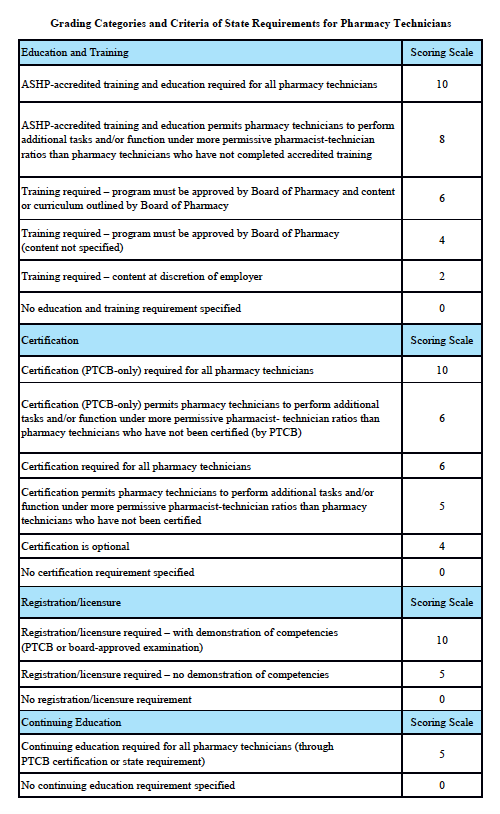
Scoring rationale for Education and Training: In order to protect the public and help ensure patient safety, it is important that pharmacy technicians are properly educated and trained. The most rigorous training is accredited training. The sole entity empowered to accredit pharmacy-technician training programs is the American Society of Health-System Pharmacists (ASHP). Please note that this is “programmatic accreditation” – not “institutional accreditation.” It is the content of the training program – as measured against established standards – that is being evaluated and accredited. Accredited training is vital to protecting patient safety because it means that a pharmacy-technician training program has met established quality standards to provide assurance and confidence to the public. For more information, please see http://www.ashp.org/menu/Accreditation/TechnicianAccreditation.aspx.
Scoring rationale for Certification: Certification is the process by which a nongovernmental agency or association grants recognition to an individual who has met certain predetermined qualifications specified by that agency or association. This is often determined by an examination process. Numerous organizations have recommended that the certification exam conducted by the Pharmacy Technician Certification Board (PTCB) should be recognized as the sole, nationally-accredited certification exam for pharmacy technician certification – including the National Association of Boards of Pharmacy (NABP), the Texas State Board of Pharmacy (TSBP), and the U.S. Department of Veterans Affairs (VA). In a recent report, NABP recommended that states be encouraged to “recognize certification by the Pharmacy Technician Certification Board (PTCB).” Moreover, NABP performed a psychometric audit of the PTCB’s pharmacy technician certification examination (PTCE) in 2001 and determined that the PTCE is psychometrically sound, defensible, and valid. In May 2010, the TSBP awarded the PTCB with the Pharmacy Technician Certification Provider contract in Texas. PTCB was selected for the contract after a rigorous bidding and evaluation process that included formal reviews and evaluations from three independent psychometricians. TSBP confidently recognizes PTCB as the single provider of certification examinations for pharmacy technicians. In addition, in June 2010, the VA began requiring PTCB certification for VA pharmacy technicians employed at grade GS-6 and above.
Scoring rationale for Registration/Licensure: Registration/licensure is the process by which the state maintains a list of all pharmacy technicians in the state and grants permission for an individual to work as a pharmacy technician in the state based on the applicant’s completion of all pre-requisites to registration/licensure – such as required training and certification.
Scoring rationale for Continuing Education: Continuing education enables pharmacy technicians to fulfill their professional responsibility to maintain competence and up-to-date knowledge and skills in an environment of technological advances and increasingly complex, new medications and therapies.
Our Mission
The Emily Jerry Foundation is determined to help make our nation’s,
world renowned, medical facilities safer for everyone, beginning with
our babies and children. We are accomplishing this very important
objective by focusing on increasing public awareness of key patient
safety related issues and identifying technology and best practices that
are proven to minimize the “human error” component of medicine.
Through our ongoing efforts The Emily Jerry Foundation is working
hard to save lives every day.




West Virginia Scorecard
Grading Scale:
A – 85-100%, B – 70-84.9%, C – 55-69.9%, D – 40-54.9%, F – 0-39.9%
Grading Categories & Criteria
West Virginia Law
I. Laws
West Virginia Code
The data contained in this 2012 Annual Scorecard are accurate as of December 2012 . Because statutes and regulations are continually revised, the data are subject to change. These data have been verified with the state board of pharmacy. This scorecard is updated on an annual basis in order to incorporate statutory and regulatory changes. A new scorecard will be issued in July 2013.
Scoring rationale for Education and Training:
In order to protect the public and help ensure patient safety, it is important that pharmacy technicians are properly educated and trained. The most rigorous training is accredited training. The sole entity empowered to accredit pharmacy-technician training programs is the American Society of Health-System Pharmacists (ASHP). Please note that this is “programmatic accreditation” – not “institutional accreditation.” It is the content of the training program – as measured against established standards – that is being evaluated and accredited. Accredited training is vital to protecting patient safety because it means that a pharmacy-technician training program has met established quality standards to provide assurance and confidence to the public. For more information, please see http://www.ashp.org/menu/Accreditation/TechnicianAccreditation.aspx.
Scoring rationale for Certification:
Certification is the process by which a nongovernmental agency or association grants recognition to an individual who has met certain predetermined qualifications specified by that agency or association. This is often determined by an examination process. Numerous organizations have recommended that the certification exam conducted by the Pharmacy Technician Certification Board (PTCB) should be recognized as the sole, nationally-accredited certification exam for pharmacy technician certification – including the National Association of Boards of Pharmacy (NABP), the Texas State Board of Pharmacy (TSBP), and the U.S. Department of Veterans Affairs (VA). In a recent report, NABP recommended that states be encouraged to “recognize certification by the Pharmacy Technician Certification Board (PTCB).” Moreover, NABP performed a psychometric audit of the PTCB’s pharmacy technician certification examination (PTCE) in 2001 and determined that the PTCE is psychometrically sound, defensible, and valid. In May 2010, the TSBP awarded the PTCB with the Pharmacy Technician Certification Provider contract in Texas. PTCB was selected for the contract after a rigorous bidding and evaluation process that included formal reviews and evaluations from three independent psychometricians. TSBP confidently recognizes PTCB as the single provider of certification examinations for pharmacy technicians. In addition, in June 2010, the VA began requiring PTCB certification for VA pharmacy technicians employed at grade GS-6 and above.
Scoring rationale for Registration/Licensure:
Registration/licensure is the process by which the state maintains a list of all pharmacy technicians in the state and grants permission for an individual to work as a pharmacy technician in the state based on the applicant’s completion of all pre-requisites to registration/licensure – such as required training and certification.
Scoring rationale for Continuing Education:
Continuing education enables pharmacy technicians to fulfill their professional responsibility to maintain competence and up-to-date knowledge and skills in an environment of technological advances and increasingly complex, new medications and therapies.
Our Mission
The Emily Jerry Foundation is determined to help make our nation’s, world renowned, medical facilities safer for everyone, beginning with our babies and children. We are accomplishing this very important objective by focusing on increasing public awareness of key patient safety related issues and identifying technology and best practices that are proven to minimize the “human error” component of medicine. Through our ongoing efforts The Emily Jerry Foundation is working hard to save lives every day.
Recent Posts
Archives