315.020 Only pharmacists to supervise manufacturing of pharmaceuticals or practice pharmacy — Exceptions — Access to pharmacy electronic database allowed under specific conditions — Persons employed to assist practice of pharmacy after April 1, 2009, to be registered pharmacy technicians or exempt under KRS 315.135.
(1) No owner of a pharmacy who is not a pharmacist shall fail to place a pharmacist in charge of his or her pharmacy or shall permit any person to compound or dispense prescription drugs, medicines, or pharmaceuticals in his or her place of business except in the presence and under the immediate supervision of a pharmacist.
(2) No manufacturer of pharmaceuticals who is not a pharmacist shall fail to place a pharmacist in charge of his or her place of business or shall permit any person to compound prescription drugs, medicines, or pharmaceuticals in his or her place of
business, except as provided by the board through the promulgation of administrative regulations pursuant to KRS Chapter 13A.
(3) Except as provided in subsection (4) of this section, no person shall engage in the practice of pharmacy unless licensed to practice under the provisions of KRS Chapter 315.
(4) The provisions of subsection (3) of this section shall not apply to:
(a) Pharmacist interns performing professional practice activities under the immediate supervision of a licensed pharmacist. The nature and scope of the activities referred to in this paragraph shall be determined by the board through administrative regulation promulgated pursuant to KRS Chapter 13A;
(b) Pharmacist interns and pharmacy technicians performing specifically identified pharmacy practice activities while under the supervision of a pharmacist. The nature and scope of the activities referred to in this paragraph shall be determined by the board through administrative regulation promulgated pursuant to KRS Chapter 13A;
(c) Other licensed health care professionals practicing within the statutory scope of their professional practices; or
(d) Volunteer health practitioners providing services under KRS 39A.350 to 39A.366.
(5) (a) As used in this subsection:
1. “”Order entry”” means the process by which pharmacy personnel validate prescription data and enter that data into a pharmacy’s dispensing or medication management system. Prescription data includes but is not limited to patient demographics, prescriber demographics, drug name, strength, dosage form, quantity, the directions for use, refill authorization, or any clarifications of the same; and
2. “”Order entry verification”” means the process by which a pharmacist verifies prescription data entered in a pharmacy’s dispensing or medication management system after order entry has been completed.
(b) Nothing in this chapter shall prohibit a pharmacist licensed in Kentucky, or a pharmacy technician registered in Kentucky or a pharmacy intern certified in Kentucky who is working under the supervision of the pharmacist, from accessing the electronic database of the pharmacy, from inside or outside of the pharmacy, to perform order entry, order entry verification, or drug regimen
review as defined in KRS 315.010, if:
1. The pharmacy has established controls to protect the confidentiality and integrity of protected health information;
2. No part of the pharmacy’s database is duplicated, downloaded, or
removed from the electronic database; and
3. The pharmacy is located in Kentucky and is permitted by the board.
(c) Supervision required by paragraph (b) of this subsection may include electronic supervision.
(d) This subsection shall only apply to:
1. Pharmacies that are not open to the public and do not dispense to walkin patients in a retail setting; or
2. Hospitals licensed under KRS Chapter 216B.
(e) Nothing in this subsection shall be construed to authorize final product verification and dispensing of a prescription from a location outside of or other than a pharmacy.
(f) Nothing in this subsection permits pharmacists, pharmacy technicians, or pharmacy interns to receive hard copy prescriptions outside of the premises of a permitted pharmacy.
(6) Effective April 1, 2009, an owner of a pharmacy shall not employ a person to assist in the practice of pharmacy unless the person is registered as a pharmacy technician by the board or exempt under KRS 315.135. Effective: July 14, 2022
History: Amended 2022 Ky. Acts ch. 72, sec. 1, effective July 14, 2022. — Amended 2021 Ky. Acts ch. 56, sec. 3, effective June 29, 2021. — Amended 2008 Ky. Acts ch. 148, sec. 7, effective July 15, 2008. — Amended 2007 Ky. Acts ch. 96, sec. 15, effective June 26, 2007. — Amended 1996 Ky. Acts ch. 257, sec. 4, effective July 15,
1996. — Amended 1982 Ky. Acts ch. 191, sec. 2, effective July 15, 1982. — Amended 1970 Ky. Acts ch. 221, sec. 2. — Recodified 1942 Ky. Acts ch. 208, sec. 1, effective October 1, 1942, from Ky. Stat. secs. 2619, 2620, 2628, 2631.” “No change.
315.030 Permit required — License required to represent oneself as pharmacist — Registration required to represent oneself as pharmacy technician.
(1) No person shall take, use or exhibit the title of drug, drug store, pharmacy or apothecary, or any combination of such names or titles, or any title, name or description of like import, or any form designed to take the place of such a title, or use any place with respect to which any of those terms are used in any advertisement or telephone directory listing, unless the facility has been issued a permit by the board.
(2) No person shall call himself or hold himself out as or use the title of “”pharmacist,”” “”registered pharmacist,”” “”licensed pharmacist,”” “”druggist,”” or use the initials “”R.Ph.”” or terms which would imply that he is a pharmacist, unless he is duly licensed under the provisions of KRS Chapter 315.
(3) Effective April 1, 2009, a person shall not call himself or herself or hold himself or herself out as a or use the title of “”pharmacy technician”” unless the person is duly registered under KRS 315.136 or 315.138.
Effective: July 15, 2008
History: Amended 2008 Ky. Acts ch. 148, sec. 9, effective July 15, 2008. — Amended 1982 Ky. Acts ch. 191, sec. 3, effective July 15, 1982. — Amended 1970 Ky. Acts ch. 221, sec. 3. — Recodified 1942 Ky. Acts ch. 208, sec. 1, effective October 1, 1942, from Ky. Stat. sec. 1376t.” “No change.
315.136 Requirements for registration as pharmacy technician.
(1) Every applicant for registration as a pharmacy technician shall be sixteen (16) years of age and of good mental health and moral character and shall file with the board an application in such form and containing such data as the board may reasonably require.
(2) The application fee shall be twenty-five dollars ($25). All applicants for registration as a pharmacy technician who serve only on a voluntary basis as a pharmacy technician with a pharmacy operated by a charitable provider as defined in KRS 142.301 shall not be required to pay the application fee.
(3) The board shall issue a certificate of registration and a pocket registration card to an applicant who meets the requirements for registration. Effective: July 15, 2010
History: Amended 2010 Ky. Acts ch. 11, sec. 1, effective July 15, 2010. — Created 2008 Ky. Acts ch. 148, sec. 2, effective July 15, 2008.
201 KAR 2:045. Technicians.
RELATES TO: KRS 315.010(12), (20), (26), 315.020(4)(b), 315.191(1)(a), (g), (l)
STATUTORY AUTHORITY: KRS 315.010(20), 315.020(4)(b), 315.191(1)(a), (g), (l)
NECESSITY, FUNCTION, AND CONFORMITY:
KRS 315.191(1)(a) authorizes the board to promulgate administrative regulations governing pharmacy technicians. KRS 315.020(4)(b) authorizes the board to establish the scope of practice for pharmacy technicians. KRS 315.010(20) and 315.191(1)(l) authorize the board to promulgate administrative regulations establishing when a pharmacy technician can practice under the general, rather than immediate, supervision of a pharmacist. This administrative regulation establishes the qualifications required for a pharmacy technician to practice under the general supervision of a pharmacist, and establishes the scope of practice for a pharmacy technician.” “Section 1. A person shall be recognized by the board as a certified pharmacy technician, if:
(1)
(a) The person has successfully completed the Pharmacy Technician Certification Exam (PTCE) administered by the Pharmacy Technician Certification Board (PTCB) or the Examination for the Certification of Pharmacy Technicians (ExCPT) by the National Healthcareer Association (NHA); and
(b) The certificate issued by the PTCB or NHA is current; or
(2) The person has successfully completed the Nuclear Pharmacy Technician Training Program at the University of Tennessee.” “Section 2. A certified pharmacy technician may perform the following functions under the general supervision of a pharmacist:
(1) Certify for delivery unit dose mobile transport systems that have been refilled by another technician;
(2) Within a nuclear pharmacy, receive diagnostic orders; and
(3)
(a) Initiate or receive a telephonic communication from a practitioner or practitioner’s agent concerning refill authorization, after the certified pharmacy technician clearly identifies himself or herself as a certified pharmacy technician; and
(b) If a practitioner or practitioner’s agent communicates information that does not relate to the refill authorization:
1. A technician shall immediately inform the pharmacist; and
2. The pharmacist shall receive the communication.” “Section 3.
(1) A technician who has not been certified by PTCB or NHA may perform the functions specified by Section 2 of this administrative regulation under the immediate supervision of a pharmacist.
(2) A function performed by a certified pharmacy technician or pharmacy technician shall be performed subject to the review of the pharmacist who directed the technician to perform the function.
(3) A pharmacist who directs a certified pharmacy technician or pharmacy technician to perform a function shall be responsible for the technician and the performance of the function.
(23 Ky.R. 3124; Am. 3806; 4108; eff. 6-16-97; 26 Ky.R. 1687; 2238; eff. 6-12-2000; 35 Ky.R. 2484; 36 Ky.R. 321; eff. 8-12-2009; 43 Ky.R. 606, 952; eff. 12-14-2016; Cert. to be Am; filing deadline 5-6-2025.)
The data contained in this 2012 Annual Scorecard are accurate as of December 2012 . Because statutes and regulations are continually revised, the data are subject to change. These data have been verified with the state board of pharmacy. This scorecard is updated on an annual basis in order to incorporate statutory and regulatory changes. A new scorecard will be issued in July 2013.
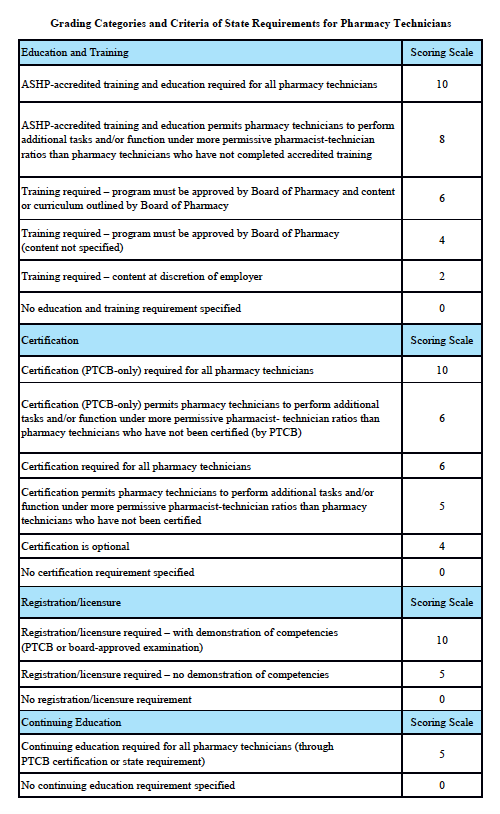
Scoring rationale for Education and Training: In order to protect the public and help ensure patient safety, it is important that pharmacy technicians are properly educated and trained. The most rigorous training is accredited training. The sole entity empowered to accredit pharmacy-technician training programs is the American Society of Health-System Pharmacists (ASHP). Please note that this is “programmatic accreditation” – not “institutional accreditation.” It is the content of the training program – as measured against established standards – that is being evaluated and accredited. Accredited training is vital to protecting patient safety because it means that a pharmacy-technician training program has met established quality standards to provide assurance and confidence to the public. For more information, please see http://www.ashp.org/menu/Accreditation/TechnicianAccreditation.aspx.
Scoring rationale for Certification: Certification is the process by which a nongovernmental agency or association grants recognition to an individual who has met certain predetermined qualifications specified by that agency or association. This is often determined by an examination process. Numerous organizations have recommended that the certification exam conducted by the Pharmacy Technician Certification Board (PTCB) should be recognized as the sole, nationally-accredited certification exam for pharmacy technician certification – including the National Association of Boards of Pharmacy (NABP), the Texas State Board of Pharmacy (TSBP), and the U.S. Department of Veterans Affairs (VA). In a recent report, NABP recommended that states be encouraged to “recognize certification by the Pharmacy Technician Certification Board (PTCB).” Moreover, NABP performed a psychometric audit of the PTCB’s pharmacy technician certification examination (PTCE) in 2001 and determined that the PTCE is psychometrically sound, defensible, and valid. In May 2010, the TSBP awarded the PTCB with the Pharmacy Technician Certification Provider contract in Texas. PTCB was selected for the contract after a rigorous bidding and evaluation process that included formal reviews and evaluations from three independent psychometricians. TSBP confidently recognizes PTCB as the single provider of certification examinations for pharmacy technicians. In addition, in June 2010, the VA began requiring PTCB certification for VA pharmacy technicians employed at grade GS-6 and above.
Scoring rationale for Registration/Licensure: Registration/licensure is the process by which the state maintains a list of all pharmacy technicians in the state and grants permission for an individual to work as a pharmacy technician in the state based on the applicant’s completion of all pre-requisites to registration/licensure – such as required training and certification.
Scoring rationale for Continuing Education: Continuing education enables pharmacy technicians to fulfill their professional responsibility to maintain competence and up-to-date knowledge and skills in an environment of technological advances and increasingly complex, new medications and therapies.
Our Mission
The Emily Jerry Foundation is determined to help make our nation’s,
world renowned, medical facilities safer for everyone, beginning with
our babies and children. We are accomplishing this very important
objective by focusing on increasing public awareness of key patient
safety related issues and identifying technology and best practices that
are proven to minimize the “human error” component of medicine.
Through our ongoing efforts The Emily Jerry Foundation is working
hard to save lives every day.




Kentucky Scorecard
Grading Scale:
A – 85-100%, B – 70-84.9%, C – 55-69.9%, D – 40-54.9%, F – 0-39.9%
Grading Categories & Criteria
Kentucky Law
I. Laws
Kentucky Revised Statutes
https://apps.legislature.ky.gov/law/statutes/chapter.aspx?id=38825
315.020 Only pharmacists to supervise manufacturing of pharmaceuticals or practice pharmacy — Exceptions — Access to pharmacy electronic database allowed under specific conditions — Persons employed to assist practice of pharmacy after April 1, 2009, to be registered pharmacy technicians or exempt under KRS 315.135.
(1) No owner of a pharmacy who is not a pharmacist shall fail to place a pharmacist in charge of his or her pharmacy or shall permit any person to compound or dispense prescription drugs, medicines, or pharmaceuticals in his or her place of business except in the presence and under the immediate supervision of a pharmacist.
(2) No manufacturer of pharmaceuticals who is not a pharmacist shall fail to place a pharmacist in charge of his or her place of business or shall permit any person to compound prescription drugs, medicines, or pharmaceuticals in his or her place of
business, except as provided by the board through the promulgation of administrative regulations pursuant to KRS Chapter 13A.
(3) Except as provided in subsection (4) of this section, no person shall engage in the practice of pharmacy unless licensed to practice under the provisions of KRS Chapter 315.
(4) The provisions of subsection (3) of this section shall not apply to:
(a) Pharmacist interns performing professional practice activities under the immediate supervision of a licensed pharmacist. The nature and scope of the activities referred to in this paragraph shall be determined by the board through administrative regulation promulgated pursuant to KRS Chapter 13A;
(b) Pharmacist interns and pharmacy technicians performing specifically identified pharmacy practice activities while under the supervision of a pharmacist. The nature and scope of the activities referred to in this paragraph shall be determined by the board through administrative regulation promulgated pursuant to KRS Chapter 13A;
(c) Other licensed health care professionals practicing within the statutory scope of their professional practices; or
(d) Volunteer health practitioners providing services under KRS 39A.350 to 39A.366.
(5) (a) As used in this subsection:
1. “”Order entry”” means the process by which pharmacy personnel validate prescription data and enter that data into a pharmacy’s dispensing or medication management system. Prescription data includes but is not limited to patient demographics, prescriber demographics, drug name, strength, dosage form, quantity, the directions for use, refill authorization, or any clarifications of the same; and
2. “”Order entry verification”” means the process by which a pharmacist verifies prescription data entered in a pharmacy’s dispensing or medication management system after order entry has been completed.
(b) Nothing in this chapter shall prohibit a pharmacist licensed in Kentucky, or a pharmacy technician registered in Kentucky or a pharmacy intern certified in Kentucky who is working under the supervision of the pharmacist, from accessing the electronic database of the pharmacy, from inside or outside of the pharmacy, to perform order entry, order entry verification, or drug regimen
review as defined in KRS 315.010, if:
1. The pharmacy has established controls to protect the confidentiality and integrity of protected health information;
2. No part of the pharmacy’s database is duplicated, downloaded, or
removed from the electronic database; and
3. The pharmacy is located in Kentucky and is permitted by the board.
(c) Supervision required by paragraph (b) of this subsection may include electronic supervision.
(d) This subsection shall only apply to:
1. Pharmacies that are not open to the public and do not dispense to walkin patients in a retail setting; or
2. Hospitals licensed under KRS Chapter 216B.
(e) Nothing in this subsection shall be construed to authorize final product verification and dispensing of a prescription from a location outside of or other than a pharmacy.
(f) Nothing in this subsection permits pharmacists, pharmacy technicians, or pharmacy interns to receive hard copy prescriptions outside of the premises of a permitted pharmacy.
(6) Effective April 1, 2009, an owner of a pharmacy shall not employ a person to assist in the practice of pharmacy unless the person is registered as a pharmacy technician by the board or exempt under KRS 315.135. Effective: July 14, 2022
History: Amended 2022 Ky. Acts ch. 72, sec. 1, effective July 14, 2022. — Amended 2021 Ky. Acts ch. 56, sec. 3, effective June 29, 2021. — Amended 2008 Ky. Acts ch. 148, sec. 7, effective July 15, 2008. — Amended 2007 Ky. Acts ch. 96, sec. 15, effective June 26, 2007. — Amended 1996 Ky. Acts ch. 257, sec. 4, effective July 15,
1996. — Amended 1982 Ky. Acts ch. 191, sec. 2, effective July 15, 1982. — Amended 1970 Ky. Acts ch. 221, sec. 2. — Recodified 1942 Ky. Acts ch. 208, sec. 1, effective October 1, 1942, from Ky. Stat. secs. 2619, 2620, 2628, 2631.” “No change.
315.030 Permit required — License required to represent oneself as pharmacist — Registration required to represent oneself as pharmacy technician.
(1) No person shall take, use or exhibit the title of drug, drug store, pharmacy or apothecary, or any combination of such names or titles, or any title, name or description of like import, or any form designed to take the place of such a title, or use any place with respect to which any of those terms are used in any advertisement or telephone directory listing, unless the facility has been issued a permit by the board.
(2) No person shall call himself or hold himself out as or use the title of “”pharmacist,”” “”registered pharmacist,”” “”licensed pharmacist,”” “”druggist,”” or use the initials “”R.Ph.”” or terms which would imply that he is a pharmacist, unless he is duly licensed under the provisions of KRS Chapter 315.
(3) Effective April 1, 2009, a person shall not call himself or herself or hold himself or herself out as a or use the title of “”pharmacy technician”” unless the person is duly registered under KRS 315.136 or 315.138.
Effective: July 15, 2008
History: Amended 2008 Ky. Acts ch. 148, sec. 9, effective July 15, 2008. — Amended 1982 Ky. Acts ch. 191, sec. 3, effective July 15, 1982. — Amended 1970 Ky. Acts ch. 221, sec. 3. — Recodified 1942 Ky. Acts ch. 208, sec. 1, effective October 1, 1942, from Ky. Stat. sec. 1376t.” “No change.
315.136 Requirements for registration as pharmacy technician.
(1) Every applicant for registration as a pharmacy technician shall be sixteen (16) years of age and of good mental health and moral character and shall file with the board an application in such form and containing such data as the board may reasonably require.
(2) The application fee shall be twenty-five dollars ($25). All applicants for registration as a pharmacy technician who serve only on a voluntary basis as a pharmacy technician with a pharmacy operated by a charitable provider as defined in KRS 142.301 shall not be required to pay the application fee.
(3) The board shall issue a certificate of registration and a pocket registration card to an applicant who meets the requirements for registration. Effective: July 15, 2010
History: Amended 2010 Ky. Acts ch. 11, sec. 1, effective July 15, 2010. — Created 2008 Ky. Acts ch. 148, sec. 2, effective July 15, 2008.
Kentucky Administrative Regulations
https://apps.legislature.ky.gov/law/kar/titles/201/002/
201 KAR 2:045. Technicians.
RELATES TO: KRS 315.010(12), (20), (26), 315.020(4)(b), 315.191(1)(a), (g), (l)
STATUTORY AUTHORITY: KRS 315.010(20), 315.020(4)(b), 315.191(1)(a), (g), (l)
NECESSITY, FUNCTION, AND CONFORMITY:
KRS 315.191(1)(a) authorizes the board to promulgate administrative regulations governing pharmacy technicians. KRS 315.020(4)(b) authorizes the board to establish the scope of practice for pharmacy technicians. KRS 315.010(20) and 315.191(1)(l) authorize the board to promulgate administrative regulations establishing when a pharmacy technician can practice under the general, rather than immediate, supervision of a pharmacist. This administrative regulation establishes the qualifications required for a pharmacy technician to practice under the general supervision of a pharmacist, and establishes the scope of practice for a pharmacy technician.” “Section 1. A person shall be recognized by the board as a certified pharmacy technician, if:
(1)
(a) The person has successfully completed the Pharmacy Technician Certification Exam (PTCE) administered by the Pharmacy Technician Certification Board (PTCB) or the Examination for the Certification of Pharmacy Technicians (ExCPT) by the National Healthcareer Association (NHA); and
(b) The certificate issued by the PTCB or NHA is current; or
(2) The person has successfully completed the Nuclear Pharmacy Technician Training Program at the University of Tennessee.” “Section 2. A certified pharmacy technician may perform the following functions under the general supervision of a pharmacist:
(1) Certify for delivery unit dose mobile transport systems that have been refilled by another technician;
(2) Within a nuclear pharmacy, receive diagnostic orders; and
(3)
(a) Initiate or receive a telephonic communication from a practitioner or practitioner’s agent concerning refill authorization, after the certified pharmacy technician clearly identifies himself or herself as a certified pharmacy technician; and
(b) If a practitioner or practitioner’s agent communicates information that does not relate to the refill authorization:
1. A technician shall immediately inform the pharmacist; and
2. The pharmacist shall receive the communication.” “Section 3.
(1) A technician who has not been certified by PTCB or NHA may perform the functions specified by Section 2 of this administrative regulation under the immediate supervision of a pharmacist.
(2) A function performed by a certified pharmacy technician or pharmacy technician shall be performed subject to the review of the pharmacist who directed the technician to perform the function.
(3) A pharmacist who directs a certified pharmacy technician or pharmacy technician to perform a function shall be responsible for the technician and the performance of the function.
(23 Ky.R. 3124; Am. 3806; 4108; eff. 6-16-97; 26 Ky.R. 1687; 2238; eff. 6-12-2000; 35 Ky.R. 2484; 36 Ky.R. 321; eff. 8-12-2009; 43 Ky.R. 606, 952; eff. 12-14-2016; Cert. to be Am; filing deadline 5-6-2025.)
References
Kentucky Revised statutes
http://www.lrc.ky.gov/krs/315-00/chapter.htm
Kansas Administrative regulations title 201 Chapter 2
http://www.lrc.state.ky.us/kar/201/002/045.htm
The data contained in this 2012 Annual Scorecard are accurate as of December 2012 . Because statutes and regulations are continually revised, the data are subject to change. These data have been verified with the state board of pharmacy. This scorecard is updated on an annual basis in order to incorporate statutory and regulatory changes. A new scorecard will be issued in July 2013.
Scoring rationale for Education and Training:
In order to protect the public and help ensure patient safety, it is important that pharmacy technicians are properly educated and trained. The most rigorous training is accredited training. The sole entity empowered to accredit pharmacy-technician training programs is the American Society of Health-System Pharmacists (ASHP). Please note that this is “programmatic accreditation” – not “institutional accreditation.” It is the content of the training program – as measured against established standards – that is being evaluated and accredited. Accredited training is vital to protecting patient safety because it means that a pharmacy-technician training program has met established quality standards to provide assurance and confidence to the public. For more information, please see http://www.ashp.org/menu/Accreditation/TechnicianAccreditation.aspx.
Scoring rationale for Certification:
Certification is the process by which a nongovernmental agency or association grants recognition to an individual who has met certain predetermined qualifications specified by that agency or association. This is often determined by an examination process. Numerous organizations have recommended that the certification exam conducted by the Pharmacy Technician Certification Board (PTCB) should be recognized as the sole, nationally-accredited certification exam for pharmacy technician certification – including the National Association of Boards of Pharmacy (NABP), the Texas State Board of Pharmacy (TSBP), and the U.S. Department of Veterans Affairs (VA). In a recent report, NABP recommended that states be encouraged to “recognize certification by the Pharmacy Technician Certification Board (PTCB).” Moreover, NABP performed a psychometric audit of the PTCB’s pharmacy technician certification examination (PTCE) in 2001 and determined that the PTCE is psychometrically sound, defensible, and valid. In May 2010, the TSBP awarded the PTCB with the Pharmacy Technician Certification Provider contract in Texas. PTCB was selected for the contract after a rigorous bidding and evaluation process that included formal reviews and evaluations from three independent psychometricians. TSBP confidently recognizes PTCB as the single provider of certification examinations for pharmacy technicians. In addition, in June 2010, the VA began requiring PTCB certification for VA pharmacy technicians employed at grade GS-6 and above.
Scoring rationale for Registration/Licensure:
Registration/licensure is the process by which the state maintains a list of all pharmacy technicians in the state and grants permission for an individual to work as a pharmacy technician in the state based on the applicant’s completion of all pre-requisites to registration/licensure – such as required training and certification.
Scoring rationale for Continuing Education:
Continuing education enables pharmacy technicians to fulfill their professional responsibility to maintain competence and up-to-date knowledge and skills in an environment of technological advances and increasingly complex, new medications and therapies.
Our Mission
The Emily Jerry Foundation is determined to help make our nation’s, world renowned, medical facilities safer for everyone, beginning with our babies and children. We are accomplishing this very important objective by focusing on increasing public awareness of key patient safety related issues and identifying technology and best practices that are proven to minimize the “human error” component of medicine. Through our ongoing efforts The Emily Jerry Foundation is working hard to save lives every day.
Recent Posts
Archives