25. Pharmacy technician. “”Pharmacy technician”” means a person employed by a pharmacy who works in a supportive role to, and under the direct supervision of, a licensed pharmacist.
[PL 2007, c. 402, Pt. DD, §2 (NEW).]” “§13721. Licensure and discipline
1. Responsibility. The board’s responsibility for the control and regulation of the practice of pharmacy in this State includes, but is not limited to, the following actions:
A. The licensing by examination or by endorsement of applicants who are qualified to engage in the practice of pharmacy under this Act; [PL 2021, c. 289, §4 (AMD).]
B. The renewal of licenses to engage in the practice of pharmacy; [PL 1987, c. 710, §5 (NEW).]
C. The determination and issuance of standards for recognition and approval of degree programs of schools and colleges of pharmacy whose graduates shall be eligible for licensure in this State
and the specification and enforcement of requirements for practical training, including internship; [PL 1987, c. 710, §5 (NEW).]
D. The inspection during business hours of all pharmacies, dispensaries, stores, hospital pharmacies, extended care facilities, boarding homes, nursing homes, substance use disorder treatment centers, penal institutions, family planning centers or other drug outlets in which drugs or medicines are manufactured, stored, distributed, compounded, dispensed or retailed in this State;
[PL 2017, c. 407, Pt. A, §145 (AMD).]
E. The licensing of any pharmacy as set out in section 13751 and any manufacturer or wholesaler whose products are distributed in this State; [PL 2007, c. 402, Pt. DD, §7 (AMD).]
F. The enforcement of those provisions of this Act relating to the conduct or competence of pharmacists practicing in this State and the processing of complaints which could lead to the suspension, revocation or restriction of licenses to engage in the practice of pharmacy; [PL 1987, c. 710, §5 (NEW).]
G. The licensing of pharmacy interns and adoption of rules governing the training, qualification and employment of pharmacy interns and pharmacy students; and [PL 2011, c. 496, §2 (AMD).]
H. The licensing of pharmacy technicians, including the fee as set under section 13724, and adoption of rules governing the training, qualification and employment of pharmacy technicians.
[PL 2007, c. 402, Pt. DD, §8 (AMD).] [PL 2021, c. 289, §4 (AMD).]
Maine Board of Pharmacy Chapter 7
Rules
1-A. License Requirement
No person other than a pharmacist or pharmacy intern may perform any of the following duties unless such other person holds a valid pharmacy technician license from the board:
1. Acceptance of an original or renewal prescription drug order;
2. Receipt of a transferred prescription for a noncontrolled drug pursuant to Chapter 19, Section 8(2) of the board’s rules;
3. Prescription data entry;
4. Prescription drug selection from inventory; or
5. Counting, packaging and labeling of prescription drugs for delivery.
The assignment of any of the above duties to a pharmacy technician lies within the discretion of the pharmacist on duty.
1. Licensure
1.Application
The pharmacy technician shall complete the application supplied by the board and provide such other information as the board may require, along with the fee required by Chapter 10 of the rules of the Department of Professional and Financial Regulation, Office of Professional and Occupational Regulation, entitled “”Establishment of License Fees.”” Applications will not be considered for approval until they are complete. Applications that remain incomplete for more than 60 days will be discarded.
2.Qualifications
The applicant shall supply verification of licensure or registration for all states in which the applicant has at any time held any type of professional or occupational license. The board may refuse to register and may refuse to renew the registration of an applicant:
A.Whose pharmacy technician license or registration has been denied, revoked, suspended or restricted in any jurisdiction for disciplinary reasons; or
B.Who has been convicted of a crime involving alcohol or drugs. This restriction is subject to consideration and waiver by the board upon presentation of satisfactory evidence that the conviction does not impair the ability of the person to conduct, with safety to the public, the duties of a pharmacy technician.
[NOTE: The effect of a criminal conviction on an applicant’s eligibility for licensure is governed generally by the Occupational License Disqualification on Basis of Criminal Record law, 5 MRSA §5301 et seq.]
3.[deleted]
4.Term of License
The license term is 1 year. Licenses may be renewed annually upon completion of a renewal application form supplied by the board and payment of the prescribed fee. No applicant may commence training or employment as a pharmacy technician until the license has been issued by the board.
5.Notice of Change of Work Site or Contact Address
A pharmacy technician shall notify the board of a change in work site, cessation of employment as a pharmacy technician or a change of contact address via letter, fax or email within 10 days after the change.
2.Training
A pharmacy that employs a pharmacy technician shall develop or deploy a training program for pharmacy technicians employed at that pharmacy. The pharmacy shall keep a copy of the training program on site at all times and shall furnish the training program to the board upon inspection or upon request. The pharmacist in charge or other Maine-licensed pharmacist designated by the pharmacy shall train each pharmacy technician in accordance with the pharmacy’s training program or shall ensure that each pharmacy technician satisfactorily completes the training program offered by the pharmacy. The training program shall accommodate the needs of the individual technician being trained.
The training program shall include specific instruction relating to the limited scope of practice of a pharmacy technician and shall clearly delineate functions that may only be performed by a pharmacist and may not be performed by a pharmacy technician.”3. [deleted]
4.Supervision by Pharmacist in Charge
1.Generally
The pharmacist in charge shall supervise pharmacy technicians employed at the pharmacy for which the pharmacist in charge is responsible. In the absence of the pharmacist in charge, a pharmacist on duty shall be the supervisor.
2.Direct Supervision
A pharmacy technician may engage in the practice of pharmacy at a pharmacy only under the direct supervision of a pharmacist as defined in Chapter 1, Section 14 of the board’s rules. The pharmacist shall physically review each prescription drug order prepared by a pharmacy technician before the product is delivered to the patient or the authorized agent of the patient. The pharmacist is responsible for the work of each pharmacy technician working under the direct supervision of the pharmacist.
5.Permissible Duties
1.Generally
The pharmacist in charge or the pharmacy shall determine the duties of pharmacy technicians based upon the needs of the pharmacy. At time of employment the pharmacist in charge shall provide the technician with a description of the tasks that the technician may perform.
Pharmacy technicians are limited to performing tasks in the dispensing of prescription legend drugs and nonjudgmental support services as set forth in Section 1-A above. Pharmacy technicians may also have access to a facsimile machine or computer used to receive original prescription drug orders via facsimile.
2.Automated Pharmacy Systems
A pharmacy technician on duty at an institutional pharmacy as described in Chapter 20, Subchapter 2, Section 1 of the board’s rules may perform the duties relating to an automated pharmacy system described in Chapter 20, Subchapter 2, Section 4(2) of the board’s rules only under the direct supervision of a pharmacist as defined in Chapter 1, Section 14(3) of the board’s rules. The pharmacist in charge or pharmacist on duty at an automated pharmacy system is responsible for the work of each pharmacy technician at a point of care location served by the automated pharmacy system.
3. Limitations
A pharmacy technician may not perform any of the following tasks:
A.[deleted];
B.Clinically evaluate a patient profile relative to drugs that have or will be dispensed;
C.Perform patient counseling;
D.Make decisions that require the education and professional training of a pharmacist; or
E.Sign any federally-required controlled substance or inventory form.
4.Responsibility of Pharmacist
The pharmacist shall verify and confirm the correctness, exactness, accuracy and completeness of the acts, tasks and functions undertaken by the pharmacy technician to assist the pharmacist in the practice of pharmacy. The pharmacist in charge, or a pharmacist on duty, is responsible for all actions performed by the pharmacy technician.
6. [deleted]
7. [deleted]
7-A. Limitation on Deployment of Pharmacy Technicians
A pharmacy and pharmacist in charge are responsible at all times for providing appropriate quality control over the work of pharmacy technicians employed at the pharmacy. A pharmacy is responsible for ensuring at all times that the number of pharmacy technicians on duty can be satisfactorily supervised by the pharmacist in charge and the pharmacists on duty.” “7-B. Administrative Responsibilities
1. Verification of Status
The pharmacist in charge shall ensure that each pharmacy technician employed at the pharmacy for which the pharmacist in charge is responsible is licensed with the board. A pharmacy technician shall carry the wallet-sized license card issued by the board at all times the technician is on duty and shall produce the card upon request of the pharmacist in charge, a pharmacist on duty or an agent of the board. No pharmacist in charge or pharmacist on duty shall permit a person who is not licensed pursuant to the terms of this chapter to perform the duties of a pharmacy technician.
2. Notice of Employment and Non-Employment of Pharmacy Technicians
The pharmacist in charge shall notify the board via letter, fax, email or on line within 10 days after the commencement or cessation of employment of any pharmacy technician at a pharmacy for which the pharmacist in charge is responsible.
3.Notice of Termination of Employment For Drug-Related Reasons or Theft
The pharmacist in charge or a designee of the pharmacist in charge shall notify the board via letter, fax, email or on line of the termination of employment of a pharmacy technician for any of the following reasons and shall include in the notice the reason for the termination. Notice shall be provided within 7 days after the termination:
A. Any drug-related reason, including but not limited to adulteration, abuse, theft or diversion;
B. Theft of non-drug merchandise; or
C. Theft of cash or credit/debit card data.
8. Exemption
Nursing personnel with access to hospital pharmacy medications at times when the pharmacy is not open need not register as pharmacy technicians.
9. Discipline
Pharmacy technicians are subject to the disciplinary provisions of 10 MRSA §8003(5-A), 32 MRSA §§ 13742-A and 13743 and Chapters 30, 31 and 32 of the board’s rules.
The data contained in this 2012 Annual Scorecard are accurate as of December 2012 . Because statutes and regulations are continually revised, the data are subject to change. These data have been verified with the state board of pharmacy. This scorecard is updated on an annual basis in order to incorporate statutory and regulatory changes. A new scorecard will be issued in July 2013.
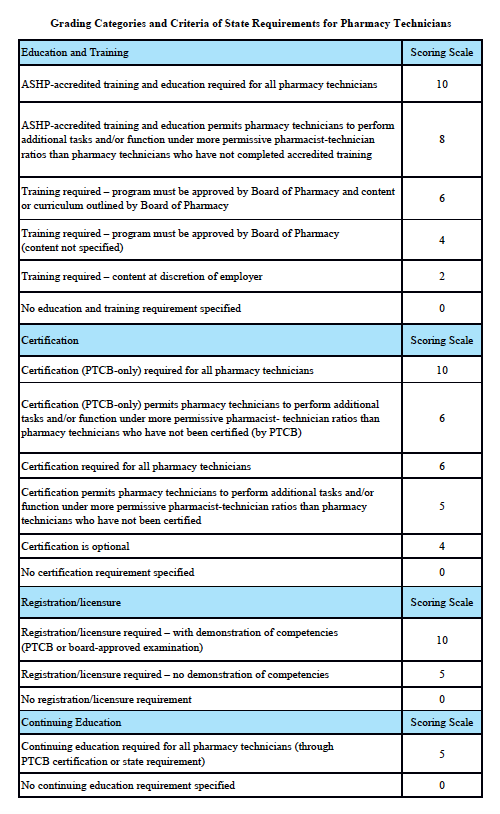
Scoring rationale for Education and Training: In order to protect the public and help ensure patient safety, it is important that pharmacy technicians are properly educated and trained. The most rigorous training is accredited training. The sole entity empowered to accredit pharmacy-technician training programs is the American Society of Health-System Pharmacists (ASHP). Please note that this is “programmatic accreditation” – not “institutional accreditation.” It is the content of the training program – as measured against established standards – that is being evaluated and accredited. Accredited training is vital to protecting patient safety because it means that a pharmacy-technician training program has met established quality standards to provide assurance and confidence to the public. For more information, please see http://www.ashp.org/menu/Accreditation/TechnicianAccreditation.aspx.
Scoring rationale for Certification: Certification is the process by which a nongovernmental agency or association grants recognition to an individual who has met certain predetermined qualifications specified by that agency or association. This is often determined by an examination process. Numerous organizations have recommended that the certification exam conducted by the Pharmacy Technician Certification Board (PTCB) should be recognized as the sole, nationally-accredited certification exam for pharmacy technician certification – including the National Association of Boards of Pharmacy (NABP), the Texas State Board of Pharmacy (TSBP), and the U.S. Department of Veterans Affairs (VA). In a recent report, NABP recommended that states be encouraged to “recognize certification by the Pharmacy Technician Certification Board (PTCB).” Moreover, NABP performed a psychometric audit of the PTCB’s pharmacy technician certification examination (PTCE) in 2001 and determined that the PTCE is psychometrically sound, defensible, and valid. In May 2010, the TSBP awarded the PTCB with the Pharmacy Technician Certification Provider contract in Texas. PTCB was selected for the contract after a rigorous bidding and evaluation process that included formal reviews and evaluations from three independent psychometricians. TSBP confidently recognizes PTCB as the single provider of certification examinations for pharmacy technicians. In addition, in June 2010, the VA began requiring PTCB certification for VA pharmacy technicians employed at grade GS-6 and above.
Scoring rationale for Registration/Licensure: Registration/licensure is the process by which the state maintains a list of all pharmacy technicians in the state and grants permission for an individual to work as a pharmacy technician in the state based on the applicant’s completion of all pre-requisites to registration/licensure – such as required training and certification.
Scoring rationale for Continuing Education: Continuing education enables pharmacy technicians to fulfill their professional responsibility to maintain competence and up-to-date knowledge and skills in an environment of technological advances and increasingly complex, new medications and therapies.
Our Mission
The Emily Jerry Foundation is determined to help make our nation’s,
world renowned, medical facilities safer for everyone, beginning with
our babies and children. We are accomplishing this very important
objective by focusing on increasing public awareness of key patient
safety related issues and identifying technology and best practices that
are proven to minimize the “human error” component of medicine.
Through our ongoing efforts The Emily Jerry Foundation is working
hard to save lives every day.




Maine Scorecard
Grading Scale:
A – 85-100%, B – 70-84.9%, C – 55-69.9%, D – 40-54.9%, F – 0-39.9%
Grading Categories & Criteria
Maine Law
I. Laws
References
Maine Pharmacy Act
http://www.mainelegislature.org/legis/statutes/32/title32ch117.pdf
Maine Board of Pharmacy Chapter 7
http://www.maine.gov/sos/cec/rules/02/392/392-all.doc
The data contained in this 2012 Annual Scorecard are accurate as of December 2012 . Because statutes and regulations are continually revised, the data are subject to change. These data have been verified with the state board of pharmacy. This scorecard is updated on an annual basis in order to incorporate statutory and regulatory changes. A new scorecard will be issued in July 2013.
Scoring rationale for Education and Training:
In order to protect the public and help ensure patient safety, it is important that pharmacy technicians are properly educated and trained. The most rigorous training is accredited training. The sole entity empowered to accredit pharmacy-technician training programs is the American Society of Health-System Pharmacists (ASHP). Please note that this is “programmatic accreditation” – not “institutional accreditation.” It is the content of the training program – as measured against established standards – that is being evaluated and accredited. Accredited training is vital to protecting patient safety because it means that a pharmacy-technician training program has met established quality standards to provide assurance and confidence to the public. For more information, please see http://www.ashp.org/menu/Accreditation/TechnicianAccreditation.aspx.
Scoring rationale for Certification:
Certification is the process by which a nongovernmental agency or association grants recognition to an individual who has met certain predetermined qualifications specified by that agency or association. This is often determined by an examination process. Numerous organizations have recommended that the certification exam conducted by the Pharmacy Technician Certification Board (PTCB) should be recognized as the sole, nationally-accredited certification exam for pharmacy technician certification – including the National Association of Boards of Pharmacy (NABP), the Texas State Board of Pharmacy (TSBP), and the U.S. Department of Veterans Affairs (VA). In a recent report, NABP recommended that states be encouraged to “recognize certification by the Pharmacy Technician Certification Board (PTCB).” Moreover, NABP performed a psychometric audit of the PTCB’s pharmacy technician certification examination (PTCE) in 2001 and determined that the PTCE is psychometrically sound, defensible, and valid. In May 2010, the TSBP awarded the PTCB with the Pharmacy Technician Certification Provider contract in Texas. PTCB was selected for the contract after a rigorous bidding and evaluation process that included formal reviews and evaluations from three independent psychometricians. TSBP confidently recognizes PTCB as the single provider of certification examinations for pharmacy technicians. In addition, in June 2010, the VA began requiring PTCB certification for VA pharmacy technicians employed at grade GS-6 and above.
Scoring rationale for Registration/Licensure:
Registration/licensure is the process by which the state maintains a list of all pharmacy technicians in the state and grants permission for an individual to work as a pharmacy technician in the state based on the applicant’s completion of all pre-requisites to registration/licensure – such as required training and certification.
Scoring rationale for Continuing Education:
Continuing education enables pharmacy technicians to fulfill their professional responsibility to maintain competence and up-to-date knowledge and skills in an environment of technological advances and increasingly complex, new medications and therapies.
Our Mission
The Emily Jerry Foundation is determined to help make our nation’s, world renowned, medical facilities safer for everyone, beginning with our babies and children. We are accomplishing this very important objective by focusing on increasing public awareness of key patient safety related issues and identifying technology and best practices that are proven to minimize the “human error” component of medicine. Through our ongoing efforts The Emily Jerry Foundation is working hard to save lives every day.
Recent Posts
Archives