12-22-102 Definitions is now 12-280-103. Definitions – rules.
(38) Pharmacy technician or certificant means a person who is certified by the board to practice as a pharmacy technician and includes a person issued a provisional certification pursuant to section 12-280-115.5 (3).
(38.5) (a) Practice as a pharmacy technician means engaging in any of the following activities involved in the practice of pharmacy, under the supervision and delegation of a supervising pharmacist:
(I) Receiving and initially inputting new written, facsimile, or electronic orders;
(II) Preparing, mixing, assembling, packaging, labeling, or delivering a drug or device;
(III) Properly and safely storing drugs or devices;
(IV) Maintaining proper records for drugs and devices;
(V) Transferring prescriptions;
(VI) Gathering, documenting, and maintaining proper clinical and nonclinical information from patients;
(VII) Replenishing automated dispensing devices without the need for pharmacist verification as long as the pharmacy technician uses bar code technology that checks the accuracy of the medication or a second pharmacy technician performs the verification;
(VIII) Performing point-of-care testing and patient care technical tasks as specifically trained for and delegated by a supervising pharmacist;
(IX) Other activities as authorized and defined by the board by rule;
(X) Redispensing a prescription drug pursuant to section 12-280-141 (9)(b) and (9)(c); and
(XI) Requesting refill authorization from the prescriber or prescriber’s agent and receiving clarifying prescription information from the prescriber or prescriber’s agent.
(b) Practice as a pharmacy technician does not include activities or services described in subsection (38.5)(a) of this section that are performed by employees or personnel of a practitioner dispensing drugs to patients pursuant to section 12-280-120 (6) or of a registered other outlet, which practitioner or other outlet does not store, compound, dispense, or deliver controlled substances.” “Add
12-280-114. Licensure, certification, or registration – applicability – applications – licensure and certification requirements – rules.
(1) This article 280 applies to all persons in this state engaged in the practice of pharmacy and to all outlets in this state engaged in the manufacture, dispensing, production, sale, and distribution of drugs, devices, and other materials used in the treatment of injury, illness, and disease.
(2) (a) Every applicant for a license or certification under this article 280 must read and write the English language, or if the applicant is a partnership, each member of the partnership must read and write the English language. If the applicant is a Colorado corporation, the corporation must be in good standing, and if the applicant is a foreign corporation, it must be qualified to do business in this state.
(b) The board shall issue the appropriate registration to each manufacturer and wholesaler that meets the requirements of this article 280 unless the board determines that the issuance of the registration would be inconsistent with the public interest. In determining the public interest, the board shall consider the following factors:
(I) Maintenance of effective controls against diversion of controlled substances into illegitimate medical, scientific, or industrial channels;
(II) Compliance with applicable state and local laws;
(III) Any conviction of the applicant under any federal or state law relating to a controlled substance;
(IV) Past experience in the manufacture or distribution of controlled substances and the existence in the applicant’s establishment of effective controls against diversion;
(V) Any false or fraudulent information in an application filed under this part 1;
(VI) Suspension or revocation of the applicant’s federal registration to manufacture, distribute, or dispense a controlled substance as authorized by federal law; and
(VII) Any other factors relevant to and consistent with the public peace, health, and safety.
(c) The board shall issue a certification to an applicant to practice as a pharmacy technician who satisfies the requirements of this article 280, this section, and section 12-280-115.5.” “Add
12-280-115.5. Certification of pharmacy technicians – requirements – provisional certification – criminal history record check – rules. (1) On or after March 30, 2020, a person shall not engage in the practice as a pharmacy technician unless the person has obtained a certification or provisional certification from the board in accordance with this section.
(2) In addition to any other requirements specified in section 12-280-114 or this article 280, to be certified as a pharmacy technician, an applicant must:
(a) Provide proof satisfactory to the board that the applicant has obtained and maintains in good standing certification as a pharmacy technician from a certifying organization; and
(b) (I) Submit to a criminal history record check in the form and manner as determined by the board by rule; or
(II) Provide proof satisfactory to the board that the applicant submitted to a criminal history record check as a condition of employment at a pharmacy or other outlet, as required by the applicant’s current employer, as a condition of participating in a course of study for or with a certifying organization, or in connection with obtaining certification from a certifying organization.
(3) (a) If an applicant for certification as a pharmacy technician has not satisfied the requirements of subsection (2)(a) of this section at the time of application to the board, the board may grant the applicant a provisional certification upon satisfaction of all other requirements for certification specified in this section and section 12-280-114.
(b) (I) Except as provided in subsection (3)(b)(II) of this section, a provisional certification is valid for not more than eighteen months after the date of issuance and is not renewable. If a person who is granted a provisional certification pursuant to this subsection (3) fails to satisfy the requirements of subsection (2)(a) of this section within eighteen months after the date the provisional certification is issued or within an extended period granted by the board pursuant to subsection (3)(b)(II) of this section, the provisional certification expires and the person shall not practice as a pharmacy technician until the person applies for and receives a certification in accordance with subsection (2) of this section.
(II) The board shall adopt rules to establish a process for a provisional certificant to apply for a hardship extension to extend the validity of the provisional certification beyond eighteen months. The board shall establish criteria for qualifying for a hardship extension based on:
(A) The negative effects on access to care in the community served by the provisional certificant or the employer of the provisional certificant;
(B) Financial hardship; or
(C) Health circumstances.
(c) A person whose provisional certification expires is not precluded from applying to the board for certification as a pharmacy technician in accordance with subsection (2) of this section.
Source: L. 2019: Entire section added, (HB 19-1242), ch. 434, p. 3750, § 6, effective October 1.” “Add
12-280-117.5. Continuing education for pharmacy technicians – exceptions – inactive status. (1) The board shall not renew, reinstate, or reactivate the certification of a pharmacy technician that was issued pursuant to section 12-280-115.5 (2) until the pharmacy technician presents evidence that the pharmacy technician maintains active certification with a certifying organization. Subject to subsection (2) of this section, the evidence may be provided by an attestation on the certification renewal application.
(2) The board may annually audit up to five percent of the pharmacy technicians certified and residing in Colorado to determine compliance with this section.
(3) If a pharmacy technician fails to complete the continuing education and renewal requirements of, and maintain active certification with, a certifying organization, the pharmacy technician’s state certification becomes inactive. An inactive certificant is not required to comply with any continuing pharmacy technician education requirement so long as the certificant remains inactive, but the certificant must continue to pay applicable fees, including renewal fees. The board shall note inactive status on the face of any certification it issues to a certificant while the certificant remains inactive. Before an inactive pharmacy technician resumes practice as a pharmacy technician after being placed on an inactive list, the pharmacy technician must file an application to activate the certification, pay the certification renewal fee, and meet the continuing education requirements of this section. If a pharmacy technician engages in practice as a pharmacy technician while on inactive status, that conduct is grounds for certification revocation under this article 280.
11.08.50 List of Pharmacy Technicians and Provisional Pharmacy Technicians. Each prescription drug outlet shall keep and maintain on a current basis a list of every pharmacy technician and provisional pharmacy technician who has practiced in that outlet at any time during the previous two years after original required certification date of March 30, 2020, including all part-time or relief personnel. This list shall show, for each such person, the following information:
a. The printed name of the person;
b. The person’s state certification number;
c. A sample of his/her initials and signature and any other identifying mark as affixed to any record required by law or rule; and
d. The date upon which such person began practicing as a pharmacy technician or provisional pharmacy technician in the prescription drug outlet.
29.00.00 PHARMACY TECHNICIANS
Rule 29.00.30 Certification requirements.
a. An applicant for a provisional or non-provisional certification shall submit an application as provided by the Board and the prescribed fee.
b. An applicant for a non-provisional certification shall submit proof that the applicant is certified by a nationally recognized certification board or body. For the purpose of obtaining a Board-issued non-provisional certification to practice as a pharmacy technician, the Board defines a “nationally recognized certification board or body” for pharmacy technicians as those boards or bodies approved by the National Association of Boards of Pharmacy (NABP) or the National Commission of Certifying Agencies (NCCA).
c. Each applicant for a provisional or non-provisional certification shall provide proof satisfactory to the Board that the applicant submitted to a criminal history check as a condition of employment at a pharmacy or other outlet, as required by the applicant’s current employer, as a condition of participating in a course of study for or with a certifying board or body, or in connection with obtaining certification from a certifying board or body.”
The data contained in this 2012 Annual Scorecard are accurate as of December 2012 . Because statutes and regulations are continually revised, the data are subject to change. These data have been verified with the state board of pharmacy. This scorecard is updated on an annual basis in order to incorporate statutory and regulatory changes. A new scorecard will be issued in July 2013.
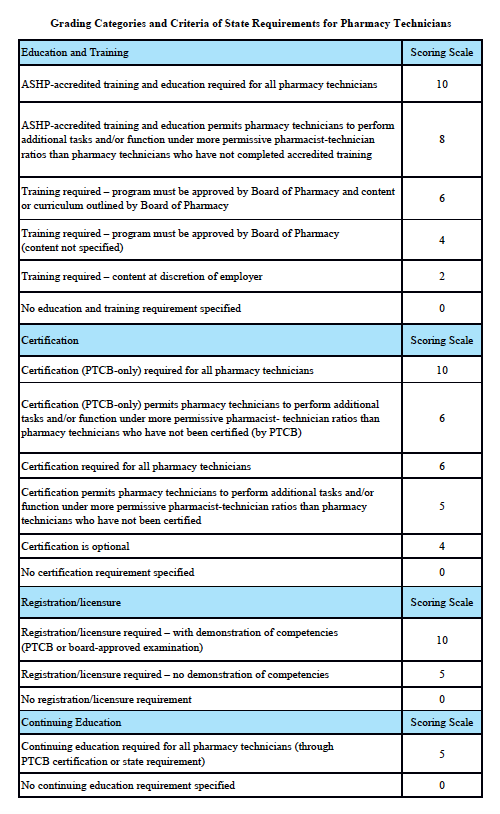
Scoring rationale for Education and Training: In order to protect the public and help ensure patient safety, it is important that pharmacy technicians are properly educated and trained. The most rigorous training is accredited training. The sole entity empowered to accredit pharmacy-technician training programs is the American Society of Health-System Pharmacists (ASHP). Please note that this is “programmatic accreditation” – not “institutional accreditation.” It is the content of the training program – as measured against established standards – that is being evaluated and accredited. Accredited training is vital to protecting patient safety because it means that a pharmacy-technician training program has met established quality standards to provide assurance and confidence to the public. For more information, please see http://www.ashp.org/menu/Accreditation/TechnicianAccreditation.aspx.
Scoring rationale for Certification: Certification is the process by which a nongovernmental agency or association grants recognition to an individual who has met certain predetermined qualifications specified by that agency or association. This is often determined by an examination process. Numerous organizations have recommended that the certification exam conducted by the Pharmacy Technician Certification Board (PTCB) should be recognized as the sole, nationally-accredited certification exam for pharmacy technician certification – including the National Association of Boards of Pharmacy (NABP), the Texas State Board of Pharmacy (TSBP), and the U.S. Department of Veterans Affairs (VA). In a recent report, NABP recommended that states be encouraged to “recognize certification by the Pharmacy Technician Certification Board (PTCB).” Moreover, NABP performed a psychometric audit of the PTCB’s pharmacy technician certification examination (PTCE) in 2001 and determined that the PTCE is psychometrically sound, defensible, and valid. In May 2010, the TSBP awarded the PTCB with the Pharmacy Technician Certification Provider contract in Texas. PTCB was selected for the contract after a rigorous bidding and evaluation process that included formal reviews and evaluations from three independent psychometricians. TSBP confidently recognizes PTCB as the single provider of certification examinations for pharmacy technicians. In addition, in June 2010, the VA began requiring PTCB certification for VA pharmacy technicians employed at grade GS-6 and above.
Scoring rationale for Registration/Licensure: Registration/licensure is the process by which the state maintains a list of all pharmacy technicians in the state and grants permission for an individual to work as a pharmacy technician in the state based on the applicant’s completion of all pre-requisites to registration/licensure – such as required training and certification.
Scoring rationale for Continuing Education: Continuing education enables pharmacy technicians to fulfill their professional responsibility to maintain competence and up-to-date knowledge and skills in an environment of technological advances and increasingly complex, new medications and therapies.
Our Mission
The Emily Jerry Foundation is determined to help make our nation’s,
world renowned, medical facilities safer for everyone, beginning with
our babies and children. We are accomplishing this very important
objective by focusing on increasing public awareness of key patient
safety related issues and identifying technology and best practices that
are proven to minimize the “human error” component of medicine.
Through our ongoing efforts The Emily Jerry Foundation is working
hard to save lives every day.




Colorado Scorecard
Grading Scale:
A – 85-100%, B – 70-84.9%, C – 55-69.9%, D – 40-54.9%, F – 0-39.9%
Grading Categories & Criteria
Colorado Law
https://leg.colorado.gov/agencies/office-legislative-legal-services/colorado-revised-statutes
or
https://leg.colorado.gov/agencies/office-legislative-legal-services/2025-crs-titles-download
12-22-102 Definitions is now 12-280-103. Definitions – rules.
(38) Pharmacy technician or certificant means a person who is certified by the board to practice as a pharmacy technician and includes a person issued a provisional certification pursuant to section 12-280-115.5 (3).
(38.5) (a) Practice as a pharmacy technician means engaging in any of the following activities involved in the practice of pharmacy, under the supervision and delegation of a supervising pharmacist:
(I) Receiving and initially inputting new written, facsimile, or electronic orders;
(II) Preparing, mixing, assembling, packaging, labeling, or delivering a drug or device;
(III) Properly and safely storing drugs or devices;
(IV) Maintaining proper records for drugs and devices;
(V) Transferring prescriptions;
(VI) Gathering, documenting, and maintaining proper clinical and nonclinical information from patients;
(VII) Replenishing automated dispensing devices without the need for pharmacist verification as long as the pharmacy technician uses bar code technology that checks the accuracy of the medication or a second pharmacy technician performs the verification;
(VIII) Performing point-of-care testing and patient care technical tasks as specifically trained for and delegated by a supervising pharmacist;
(IX) Other activities as authorized and defined by the board by rule;
(X) Redispensing a prescription drug pursuant to section 12-280-141 (9)(b) and (9)(c); and
(XI) Requesting refill authorization from the prescriber or prescriber’s agent and receiving clarifying prescription information from the prescriber or prescriber’s agent.
(b) Practice as a pharmacy technician does not include activities or services described in subsection (38.5)(a) of this section that are performed by employees or personnel of a practitioner dispensing drugs to patients pursuant to section 12-280-120 (6) or of a registered other outlet, which practitioner or other outlet does not store, compound, dispense, or deliver controlled substances.” “Add
12-280-114. Licensure, certification, or registration – applicability – applications – licensure and certification requirements – rules.
(1) This article 280 applies to all persons in this state engaged in the practice of pharmacy and to all outlets in this state engaged in the manufacture, dispensing, production, sale, and distribution of drugs, devices, and other materials used in the treatment of injury, illness, and disease.
(2) (a) Every applicant for a license or certification under this article 280 must read and write the English language, or if the applicant is a partnership, each member of the partnership must read and write the English language. If the applicant is a Colorado corporation, the corporation must be in good standing, and if the applicant is a foreign corporation, it must be qualified to do business in this state.
(b) The board shall issue the appropriate registration to each manufacturer and wholesaler that meets the requirements of this article 280 unless the board determines that the issuance of the registration would be inconsistent with the public interest. In determining the public interest, the board shall consider the following factors:
(I) Maintenance of effective controls against diversion of controlled substances into illegitimate medical, scientific, or industrial channels;
(II) Compliance with applicable state and local laws;
(III) Any conviction of the applicant under any federal or state law relating to a controlled substance;
(IV) Past experience in the manufacture or distribution of controlled substances and the existence in the applicant’s establishment of effective controls against diversion;
(V) Any false or fraudulent information in an application filed under this part 1;
(VI) Suspension or revocation of the applicant’s federal registration to manufacture, distribute, or dispense a controlled substance as authorized by federal law; and
(VII) Any other factors relevant to and consistent with the public peace, health, and safety.
(c) The board shall issue a certification to an applicant to practice as a pharmacy technician who satisfies the requirements of this article 280, this section, and section 12-280-115.5.” “Add
12-280-115.5. Certification of pharmacy technicians – requirements – provisional certification – criminal history record check – rules. (1) On or after March 30, 2020, a person shall not engage in the practice as a pharmacy technician unless the person has obtained a certification or provisional certification from the board in accordance with this section.
(2) In addition to any other requirements specified in section 12-280-114 or this article 280, to be certified as a pharmacy technician, an applicant must:
(a) Provide proof satisfactory to the board that the applicant has obtained and maintains in good standing certification as a pharmacy technician from a certifying organization; and
(b) (I) Submit to a criminal history record check in the form and manner as determined by the board by rule; or
(II) Provide proof satisfactory to the board that the applicant submitted to a criminal history record check as a condition of employment at a pharmacy or other outlet, as required by the applicant’s current employer, as a condition of participating in a course of study for or with a certifying organization, or in connection with obtaining certification from a certifying organization.
(3) (a) If an applicant for certification as a pharmacy technician has not satisfied the requirements of subsection (2)(a) of this section at the time of application to the board, the board may grant the applicant a provisional certification upon satisfaction of all other requirements for certification specified in this section and section 12-280-114.
(b) (I) Except as provided in subsection (3)(b)(II) of this section, a provisional certification is valid for not more than eighteen months after the date of issuance and is not renewable. If a person who is granted a provisional certification pursuant to this subsection (3) fails to satisfy the requirements of subsection (2)(a) of this section within eighteen months after the date the provisional certification is issued or within an extended period granted by the board pursuant to subsection (3)(b)(II) of this section, the provisional certification expires and the person shall not practice as a pharmacy technician until the person applies for and receives a certification in accordance with subsection (2) of this section.
(II) The board shall adopt rules to establish a process for a provisional certificant to apply for a hardship extension to extend the validity of the provisional certification beyond eighteen months. The board shall establish criteria for qualifying for a hardship extension based on:
(A) The negative effects on access to care in the community served by the provisional certificant or the employer of the provisional certificant;
(B) Financial hardship; or
(C) Health circumstances.
(c) A person whose provisional certification expires is not precluded from applying to the board for certification as a pharmacy technician in accordance with subsection (2) of this section.
Source: L. 2019: Entire section added, (HB 19-1242), ch. 434, p. 3750, § 6, effective October 1.” “Add
12-280-117.5. Continuing education for pharmacy technicians – exceptions – inactive status. (1) The board shall not renew, reinstate, or reactivate the certification of a pharmacy technician that was issued pursuant to section 12-280-115.5 (2) until the pharmacy technician presents evidence that the pharmacy technician maintains active certification with a certifying organization. Subject to subsection (2) of this section, the evidence may be provided by an attestation on the certification renewal application.
(2) The board may annually audit up to five percent of the pharmacy technicians certified and residing in Colorado to determine compliance with this section.
(3) If a pharmacy technician fails to complete the continuing education and renewal requirements of, and maintain active certification with, a certifying organization, the pharmacy technician’s state certification becomes inactive. An inactive certificant is not required to comply with any continuing pharmacy technician education requirement so long as the certificant remains inactive, but the certificant must continue to pay applicable fees, including renewal fees. The board shall note inactive status on the face of any certification it issues to a certificant while the certificant remains inactive. Before an inactive pharmacy technician resumes practice as a pharmacy technician after being placed on an inactive list, the pharmacy technician must file an application to activate the certification, pay the certification renewal fee, and meet the continuing education requirements of this section. If a pharmacy technician engages in practice as a pharmacy technician while on inactive status, that conduct is grounds for certification revocation under this article 280.
https://www.sos.state.co.us/CCR/DisplayRule.do?action=ruleinfo&ruleId=2254&deptID=18&agencyID=87&deptName=Department%20of%20Regulatory%20Agencies&agencyName=Division%20of%20Professions%20and%20Occupations%20-%20State%20Board%20of%20Pharmacy&seriesNum=3%20CCR%20719-1
11.08.50 List of Pharmacy Technicians and Provisional Pharmacy Technicians. Each prescription drug outlet shall keep and maintain on a current basis a list of every pharmacy technician and provisional pharmacy technician who has practiced in that outlet at any time during the previous two years after original required certification date of March 30, 2020, including all part-time or relief personnel. This list shall show, for each such person, the following information:
a. The printed name of the person;
b. The person’s state certification number;
c. A sample of his/her initials and signature and any other identifying mark as affixed to any record required by law or rule; and
d. The date upon which such person began practicing as a pharmacy technician or provisional pharmacy technician in the prescription drug outlet.
29.00.00 PHARMACY TECHNICIANS
Rule 29.00.30 Certification requirements.
a. An applicant for a provisional or non-provisional certification shall submit an application as provided by the Board and the prescribed fee.
b. An applicant for a non-provisional certification shall submit proof that the applicant is certified by a nationally recognized certification board or body. For the purpose of obtaining a Board-issued non-provisional certification to practice as a pharmacy technician, the Board defines a “nationally recognized certification board or body” for pharmacy technicians as those boards or bodies approved by the National Association of Boards of Pharmacy (NABP) or the National Commission of Certifying Agencies (NCCA).
c. Each applicant for a provisional or non-provisional certification shall provide proof satisfactory to the Board that the applicant submitted to a criminal history check as a condition of employment at a pharmacy or other outlet, as required by the applicant’s current employer, as a condition of participating in a course of study for or with a certifying board or body, or in connection with obtaining certification from a certifying board or body.”
References
Colorado Statutes
http://www.dora.state.co.us/pharmacy/Statute.pdf
Pharmacy Rules and Regulations
http://www.dora.state.co.us/pharmacy/bus/technician_posting_log.pdf
The data contained in this 2012 Annual Scorecard are accurate as of December 2012 . Because statutes and regulations are continually revised, the data are subject to change. These data have been verified with the state board of pharmacy. This scorecard is updated on an annual basis in order to incorporate statutory and regulatory changes. A new scorecard will be issued in July 2013.
Scoring rationale for Education and Training:
In order to protect the public and help ensure patient safety, it is important that pharmacy technicians are properly educated and trained. The most rigorous training is accredited training. The sole entity empowered to accredit pharmacy-technician training programs is the American Society of Health-System Pharmacists (ASHP). Please note that this is “programmatic accreditation” – not “institutional accreditation.” It is the content of the training program – as measured against established standards – that is being evaluated and accredited. Accredited training is vital to protecting patient safety because it means that a pharmacy-technician training program has met established quality standards to provide assurance and confidence to the public. For more information, please see http://www.ashp.org/menu/Accreditation/TechnicianAccreditation.aspx.
Scoring rationale for Certification:
Certification is the process by which a nongovernmental agency or association grants recognition to an individual who has met certain predetermined qualifications specified by that agency or association. This is often determined by an examination process. Numerous organizations have recommended that the certification exam conducted by the Pharmacy Technician Certification Board (PTCB) should be recognized as the sole, nationally-accredited certification exam for pharmacy technician certification – including the National Association of Boards of Pharmacy (NABP), the Texas State Board of Pharmacy (TSBP), and the U.S. Department of Veterans Affairs (VA). In a recent report, NABP recommended that states be encouraged to “recognize certification by the Pharmacy Technician Certification Board (PTCB).” Moreover, NABP performed a psychometric audit of the PTCB’s pharmacy technician certification examination (PTCE) in 2001 and determined that the PTCE is psychometrically sound, defensible, and valid. In May 2010, the TSBP awarded the PTCB with the Pharmacy Technician Certification Provider contract in Texas. PTCB was selected for the contract after a rigorous bidding and evaluation process that included formal reviews and evaluations from three independent psychometricians. TSBP confidently recognizes PTCB as the single provider of certification examinations for pharmacy technicians. In addition, in June 2010, the VA began requiring PTCB certification for VA pharmacy technicians employed at grade GS-6 and above.
Scoring rationale for Registration/Licensure:
Registration/licensure is the process by which the state maintains a list of all pharmacy technicians in the state and grants permission for an individual to work as a pharmacy technician in the state based on the applicant’s completion of all pre-requisites to registration/licensure – such as required training and certification.
Scoring rationale for Continuing Education:
Continuing education enables pharmacy technicians to fulfill their professional responsibility to maintain competence and up-to-date knowledge and skills in an environment of technological advances and increasingly complex, new medications and therapies.
Our Mission
The Emily Jerry Foundation is determined to help make our nation’s, world renowned, medical facilities safer for everyone, beginning with our babies and children. We are accomplishing this very important objective by focusing on increasing public awareness of key patient safety related issues and identifying technology and best practices that are proven to minimize the “human error” component of medicine. Through our ongoing efforts The Emily Jerry Foundation is working hard to save lives every day.
Recent Posts
Archives