Section 26-4-82 – Duties requiring professional judgment; responsibilities of licensed pharmacist
(a) In dispensing drugs, no individual other than a licensed pharmacist shall perform or conduct those duties or functions which require professional judgment. It shall be the responsibility of the supervising pharmacist to ensure that no other employee of the pharmacy, including pharmacy technicians, performs or conducts those duties or functions which require professional judgment.
(b) For all prescriptions, it shall be the responsibility of the pharmacist on duty at a facility to ensure that only a pharmacist or a pharmacy intern under the direct supervision of a pharmacist provides professional consultation and counseling with patients or other licensed health care professionals, and that only a pharmacist or a pharmacy intern under the direct supervision of a pharmacist accepts initial telephoned prescription orders or provides information in any manner relative to prescriptions or prescription drugs.
(c) In the dispensing of all prescription drug orders:
(1) The pharmacist shall be responsible for all activities of the pharmacy technician in the preparation of the drug for delivery to the patient;
(2) The pharmacist shall be present and personally supervising the activities of the pharmacy technician at all times;
(3) When electronic systems are employed within the pharmacy, pharmacy technicians may enter information into the system and prepare labels; provided, however, that it shall be the responsibility of the pharmacist to verify the accuracy of the information entered and the label produced in conjunction with the prescription drug order;
(4) When a prescription drug order is presented for refilling, it shall be the responsibility of the pharmacist to review all appropriate information and make the determination as to whether to refill the prescription drug order; and
(5) Pharmacy technicians in the dispensing area shall be easily identifiable.
(d) The board of pharmacy shall promulgate rules and regulations regarding the activities and utilization of pharmacy technicians in pharmacies, including the establishment of a registry as required in paragraph (7) of subsection (a) of Code Section 26-4-28; provided, however, that the pharmacist to pharmacy technician ratio shall not exceed one pharmacist providing direct supervision of four pharmacy technicians. The board may consider and approve an application to increase the ratio in a pharmacy located in a licensed hospital or in a closed-door pharmacy. Such application must be made in writing and must be submitted to the board by the pharmacist in charge of a specific hospital pharmacy in this state or a specific closed-door pharmacy. At any time during which the pharmacist directly supervises four or more pharmacy technicians, two of such technicians must be certified. At any time during which the pharmacist directly supervises three pharmacy technicians, one of such technicians must be certified. No certification is required for pharmacy technicians in pharmacies at any time during which the pharmacist directly supervises one or two pharmacy technicians. In order to be certified, pharmacy technicians must:
(1) Have successfully passed a certification program approved by the board of pharmacy;
(2) Have successfully passed an employer’s training and assessment program which has been approved by the board of pharmacy; or
(3) Have been certified by either the Pharmacy Technician Certification Board or any other nationally recognized certifying body approved by the board of pharmacy.
As used in this subsection, the term “”closed-door pharmacy”” means a pharmacy that provides specialized services and is not open to the general public.
(e) In addition to the utilization of pharmacy technicians, a pharmacist may be assisted by and directly supervise one pharmacy intern and one pharmacy extern.
Amended by 2024 Ga. Laws 473,§ 1-1, eff. 4/23/2024.
Amended by 2021 Ga. Laws 19,§ 1, eff. 7/1/2021.
Amended by 2007 Ga. Laws 130,§ 2, eff. 5/18/2007.
Amended by 2002 Ga. Laws 1000, § 1, eff. 7/1/2002.
Rule 480-15-.01 Definitions
(b) “”Certified pharmacy technician”” shall mean a registered pharmacy technician who has either successfully passed a certification program approved by the Board, or has successfully passed an employer’s training and assessment program approved by the Board, or has been certified by either the Pharmacy Technician Certification Board (PTCB) or any other nationally recognized certifying body approved by the Board.
(g) “”Registered Pharmacy technician”” shall mean those support persons registered with the board who are utilized in pharmacies and whose responsibilities are to provide nonjudgmental technical services concerned with the preparation for dispensing of drugs under the direct supervision and responsibility of a pharmacist.” “Rule 480-15-.02 Registration of Pharmacy Technicians and Continuing Education Requirements
(1) Effective August 1, 2011, a pharmacy may only employ registered pharmacy technicians to perform pharmacy technician duties.
(2) In order to be registered as a Pharmacy Technician in this State, an applicant shall:
(a) Submit an application to the Board on the form prescribed by the Board;
1. Mere submission of an application to the Board is not registration pursuant to this Rule.
2. No applicant shall be deemed registered until such time as his/her application has been completely processed by the Board’s administrative office, to include receipt and processing of any applicable fees, and a registration number has issued to the applicant;
(b) Attest that applicant is at least 17 years old;
(c) Attest that applicant is currently enrolled in high school, or has a high school diploma, or has a GED, or has a postsecondary education or college degree;
(d) Consent to, provide the necessary information to conduct, and pay for a background check to be conducted by the Board, its agent or a firm or firms approved by the Board, which background check will include a criminal history, driver license history and other information as the Board deems necessary, and will authorize the Board and the Georgia Drugs and Narcotics Agency to receive the results;
(e) Submit the name and address of employer and place of employment;
(f) Pay application fees; and
(g) If certified, submit evidence of training supporting designation as certified.
(3) The Board may deny registration or conditionally grant registration for any of the reasons set forth in Code sections 26-4-60 or 43-1-19. This includes convictions, pleas of nolo contendere and guilty pleas related to misdemeanor crimes of moral turpitude or marijuana and to felonies. In addition, no pharmacist whose license has been denied, revoked, suspended, or restricted for disciplinary purposes shall be eligible to be registered as a pharmacy technician.
(4) The denial of an application for registration as a pharmacy technician shall not be a contested case and the applicant shall not be entitled to a hearing under the Georgia Administrative Procedures Action, O.C.G.A. T. 50, Ch. 13, but such applicant may be entitled to an appearance before the Board.
(5) A registration, once issued, is renewable biennially, upon payment of a fee. Registrations shall expire on June 30th of each odd-numbered year. If the application for renewal is not made and the fee paid before September 1st of the odd-numbered year, the registration shall lapse and shall not be renewed. An application for a new registration shall be required.
(6) On and after July 1, 2023, as a requirement for the biennial renewal of his/her registration, a pharmacy technician must complete not less than twenty (20) hours of approved continuing education.
(a) “”Approved continuing education”” means courses approved by the Board as described in Rule 480-3-.03.
(b) One hour of C.E. is defined as 0.1 C.E.U. Each pharmacy technician in the State of Georgia must obtain 20 hours of continuing education or 2.0 C.E.U.’s per biennium for registration renewal.
1. Certificates documenting 20 hours of approved continuing education or 2.0 C.E.U.’s must be completed and date within the biennium.
(c) C.E. requirements during the technician’s first biennial registration cycle:
1. A pharmacy technician registered during the first six (6) months of the biennium (July 1, Year-One to December 31, Year-One), shall be required to obtain 20 hours of C.E.
2. A pharmacy technician registered during the following twelve (12) months (January 1, Year-Two to December 31, Year-Two), shall be required to obtain 10 hours of C.E.
3. A pharmacy technician registered during the last six (6) months (January 1, Year-Three to June 30, Year-Three) of the biennium, shall be exempt from continuing education for that biennium only.
(d) In the event of an audit and a pharmacy technician fails to submit certificates, which document his/her required continuing education credits, the Board will not process his/her request to renew the registration until the continuing education requirements are provided to the Board.
1. The pharmacy technician may not carry over continuing education credits from one registration period to the next.
2. Nothing is meant to prohibit representatives from the Georgia Drugs and Narcotics Agency (GDNA) from checking, auditing, or verifying a pharmacy technician’s continuing education certificates as needed.
3. Each registered pharmacy technician shall maintain these certificates of attendance at continuing education meetings for a period of two (2) years from the date of the preceding renewal period.
(e) The staff of the Georgia Board of Pharmacy may audit, or otherwise select randomly, the continuing education of a percentage of registrants as determined by the Board.
(7) A registrant has a responsibility to update the Board with a change of home address and employment address within ten (10) days of such change.”
The data contained in this 2012 Annual Scorecard are accurate as of December 2012 . Because statutes and regulations are continually revised, the data are subject to change. These data have been verified with the state board of pharmacy. This scorecard is updated on an annual basis in order to incorporate statutory and regulatory changes. A new scorecard will be issued in July 2013.
Scoring rationale for Education and Training: In order to protect the public and help ensure patient safety, it is important that pharmacy technicians are properly educated and trained. The most rigorous training is accredited training. The sole entity empowered to accredit pharmacy-technician training programs is the American Society of Health-System Pharmacists (ASHP). Please note that this is “programmatic accreditation” – not “institutional accreditation.” It is the content of the training program – as measured against established standards – that is being evaluated and accredited. Accredited training is vital to protecting patient safety because it means that a pharmacy-technician training program has met established quality standards to provide assurance and confidence to the public. For more information, please see http://www.ashp.org/menu/Accreditation/TechnicianAccreditation.aspx.
Scoring rationale for Certification: Certification is the process by which a nongovernmental agency or association grants recognition to an individual who has met certain predetermined qualifications specified by that agency or association. This is often determined by an examination process. Numerous organizations have recommended that the certification exam conducted by the Pharmacy Technician Certification Board (PTCB) should be recognized as the sole, nationally-accredited certification exam for pharmacy technician certification – including the National Association of Boards of Pharmacy (NABP), the Texas State Board of Pharmacy (TSBP), and the U.S. Department of Veterans Affairs (VA). In a recent report, NABP recommended that states be encouraged to “recognize certification by the Pharmacy Technician Certification Board (PTCB).” Moreover, NABP performed a psychometric audit of the PTCB’s pharmacy technician certification examination (PTCE) in 2001 and determined that the PTCE is psychometrically sound, defensible, and valid. In May 2010, the TSBP awarded the PTCB with the Pharmacy Technician Certification Provider contract in Texas. PTCB was selected for the contract after a rigorous bidding and evaluation process that included formal reviews and evaluations from three independent psychometricians. TSBP confidently recognizes PTCB as the single provider of certification examinations for pharmacy technicians. In addition, in June 2010, the VA began requiring PTCB certification for VA pharmacy technicians employed at grade GS-6 and above.
Scoring rationale for Registration/Licensure: Registration/licensure is the process by which the state maintains a list of all pharmacy technicians in the state and grants permission for an individual to work as a pharmacy technician in the state based on the applicant’s completion of all pre-requisites to registration/licensure – such as required training and certification.
Scoring rationale for Continuing Education: Continuing education enables pharmacy technicians to fulfill their professional responsibility to maintain competence and up-to-date knowledge and skills in an environment of technological advances and increasingly complex, new medications and therapies.
Our Mission
The Emily Jerry Foundation is determined to help make our nation’s,
world renowned, medical facilities safer for everyone, beginning with
our babies and children. We are accomplishing this very important
objective by focusing on increasing public awareness of key patient
safety related issues and identifying technology and best practices that
are proven to minimize the “human error” component of medicine.
Through our ongoing efforts The Emily Jerry Foundation is working
hard to save lives every day.




Georgia Scorecard
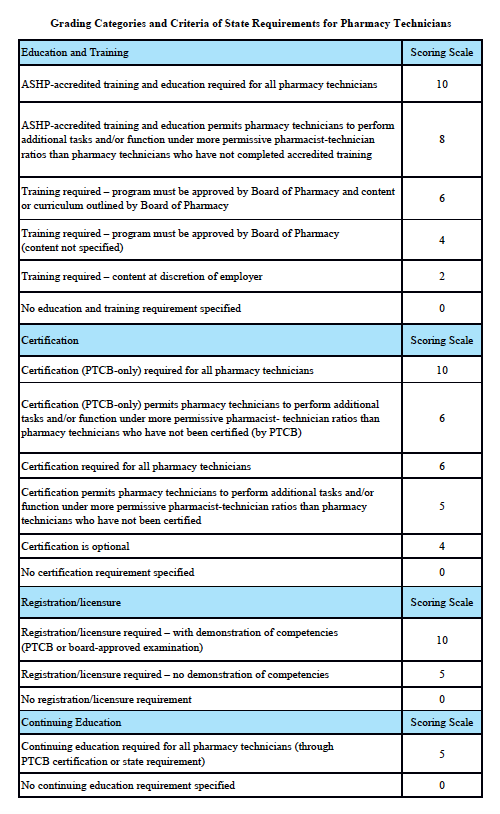
Grading Scale:
A – 85-100%, B – 70-84.9%, C – 55-69.9%, D – 40-54.9%, F – 0-39.9%
Grading Categories & Criteria
Georgia Law
I. Laws
Georgia Pharmacy Practice Act
https://gbp.georgia.gov/documents/georgia-law
Section 26-4-82 – Duties requiring professional judgment; responsibilities of licensed pharmacist
(a) In dispensing drugs, no individual other than a licensed pharmacist shall perform or conduct those duties or functions which require professional judgment. It shall be the responsibility of the supervising pharmacist to ensure that no other employee of the pharmacy, including pharmacy technicians, performs or conducts those duties or functions which require professional judgment.
(b) For all prescriptions, it shall be the responsibility of the pharmacist on duty at a facility to ensure that only a pharmacist or a pharmacy intern under the direct supervision of a pharmacist provides professional consultation and counseling with patients or other licensed health care professionals, and that only a pharmacist or a pharmacy intern under the direct supervision of a pharmacist accepts initial telephoned prescription orders or provides information in any manner relative to prescriptions or prescription drugs.
(c) In the dispensing of all prescription drug orders:
(1) The pharmacist shall be responsible for all activities of the pharmacy technician in the preparation of the drug for delivery to the patient;
(2) The pharmacist shall be present and personally supervising the activities of the pharmacy technician at all times;
(3) When electronic systems are employed within the pharmacy, pharmacy technicians may enter information into the system and prepare labels; provided, however, that it shall be the responsibility of the pharmacist to verify the accuracy of the information entered and the label produced in conjunction with the prescription drug order;
(4) When a prescription drug order is presented for refilling, it shall be the responsibility of the pharmacist to review all appropriate information and make the determination as to whether to refill the prescription drug order; and
(5) Pharmacy technicians in the dispensing area shall be easily identifiable.
(d) The board of pharmacy shall promulgate rules and regulations regarding the activities and utilization of pharmacy technicians in pharmacies, including the establishment of a registry as required in paragraph (7) of subsection (a) of Code Section 26-4-28; provided, however, that the pharmacist to pharmacy technician ratio shall not exceed one pharmacist providing direct supervision of four pharmacy technicians. The board may consider and approve an application to increase the ratio in a pharmacy located in a licensed hospital or in a closed-door pharmacy. Such application must be made in writing and must be submitted to the board by the pharmacist in charge of a specific hospital pharmacy in this state or a specific closed-door pharmacy. At any time during which the pharmacist directly supervises four or more pharmacy technicians, two of such technicians must be certified. At any time during which the pharmacist directly supervises three pharmacy technicians, one of such technicians must be certified. No certification is required for pharmacy technicians in pharmacies at any time during which the pharmacist directly supervises one or two pharmacy technicians. In order to be certified, pharmacy technicians must:
(1) Have successfully passed a certification program approved by the board of pharmacy;
(2) Have successfully passed an employer’s training and assessment program which has been approved by the board of pharmacy; or
(3) Have been certified by either the Pharmacy Technician Certification Board or any other nationally recognized certifying body approved by the board of pharmacy.
As used in this subsection, the term “”closed-door pharmacy”” means a pharmacy that provides specialized services and is not open to the general public.
(e) In addition to the utilization of pharmacy technicians, a pharmacist may be assisted by and directly supervise one pharmacy intern and one pharmacy extern.
Amended by 2024 Ga. Laws 473,§ 1-1, eff. 4/23/2024.
Amended by 2021 Ga. Laws 19,§ 1, eff. 7/1/2021.
Amended by 2007 Ga. Laws 130,§ 2, eff. 5/18/2007.
Amended by 2002 Ga. Laws 1000, § 1, eff. 7/1/2002.
Board of Pharmacy Rules
https://rules.sos.state.ga.us/gac/480
Rule 480-15-.01 Definitions
(b) “”Certified pharmacy technician”” shall mean a registered pharmacy technician who has either successfully passed a certification program approved by the Board, or has successfully passed an employer’s training and assessment program approved by the Board, or has been certified by either the Pharmacy Technician Certification Board (PTCB) or any other nationally recognized certifying body approved by the Board.
(g) “”Registered Pharmacy technician”” shall mean those support persons registered with the board who are utilized in pharmacies and whose responsibilities are to provide nonjudgmental technical services concerned with the preparation for dispensing of drugs under the direct supervision and responsibility of a pharmacist.” “Rule 480-15-.02 Registration of Pharmacy Technicians and Continuing Education Requirements
(1) Effective August 1, 2011, a pharmacy may only employ registered pharmacy technicians to perform pharmacy technician duties.
(2) In order to be registered as a Pharmacy Technician in this State, an applicant shall:
(a) Submit an application to the Board on the form prescribed by the Board;
1. Mere submission of an application to the Board is not registration pursuant to this Rule.
2. No applicant shall be deemed registered until such time as his/her application has been completely processed by the Board’s administrative office, to include receipt and processing of any applicable fees, and a registration number has issued to the applicant;
(b) Attest that applicant is at least 17 years old;
(c) Attest that applicant is currently enrolled in high school, or has a high school diploma, or has a GED, or has a postsecondary education or college degree;
(d) Consent to, provide the necessary information to conduct, and pay for a background check to be conducted by the Board, its agent or a firm or firms approved by the Board, which background check will include a criminal history, driver license history and other information as the Board deems necessary, and will authorize the Board and the Georgia Drugs and Narcotics Agency to receive the results;
(e) Submit the name and address of employer and place of employment;
(f) Pay application fees; and
(g) If certified, submit evidence of training supporting designation as certified.
(3) The Board may deny registration or conditionally grant registration for any of the reasons set forth in Code sections 26-4-60 or 43-1-19. This includes convictions, pleas of nolo contendere and guilty pleas related to misdemeanor crimes of moral turpitude or marijuana and to felonies. In addition, no pharmacist whose license has been denied, revoked, suspended, or restricted for disciplinary purposes shall be eligible to be registered as a pharmacy technician.
(4) The denial of an application for registration as a pharmacy technician shall not be a contested case and the applicant shall not be entitled to a hearing under the Georgia Administrative Procedures Action, O.C.G.A. T. 50, Ch. 13, but such applicant may be entitled to an appearance before the Board.
(5) A registration, once issued, is renewable biennially, upon payment of a fee. Registrations shall expire on June 30th of each odd-numbered year. If the application for renewal is not made and the fee paid before September 1st of the odd-numbered year, the registration shall lapse and shall not be renewed. An application for a new registration shall be required.
(6) On and after July 1, 2023, as a requirement for the biennial renewal of his/her registration, a pharmacy technician must complete not less than twenty (20) hours of approved continuing education.
(a) “”Approved continuing education”” means courses approved by the Board as described in Rule 480-3-.03.
(b) One hour of C.E. is defined as 0.1 C.E.U. Each pharmacy technician in the State of Georgia must obtain 20 hours of continuing education or 2.0 C.E.U.’s per biennium for registration renewal.
1. Certificates documenting 20 hours of approved continuing education or 2.0 C.E.U.’s must be completed and date within the biennium.
(c) C.E. requirements during the technician’s first biennial registration cycle:
1. A pharmacy technician registered during the first six (6) months of the biennium (July 1, Year-One to December 31, Year-One), shall be required to obtain 20 hours of C.E.
2. A pharmacy technician registered during the following twelve (12) months (January 1, Year-Two to December 31, Year-Two), shall be required to obtain 10 hours of C.E.
3. A pharmacy technician registered during the last six (6) months (January 1, Year-Three to June 30, Year-Three) of the biennium, shall be exempt from continuing education for that biennium only.
(d) In the event of an audit and a pharmacy technician fails to submit certificates, which document his/her required continuing education credits, the Board will not process his/her request to renew the registration until the continuing education requirements are provided to the Board.
1. The pharmacy technician may not carry over continuing education credits from one registration period to the next.
2. Nothing is meant to prohibit representatives from the Georgia Drugs and Narcotics Agency (GDNA) from checking, auditing, or verifying a pharmacy technician’s continuing education certificates as needed.
3. Each registered pharmacy technician shall maintain these certificates of attendance at continuing education meetings for a period of two (2) years from the date of the preceding renewal period.
(e) The staff of the Georgia Board of Pharmacy may audit, or otherwise select randomly, the continuing education of a percentage of registrants as determined by the Board.
(7) A registrant has a responsibility to update the Board with a change of home address and employment address within ten (10) days of such change.”
References
Georgia Pharmacy Practice Act
http://sos.georgia.gov/acrobat/PLB/laws/03_Pharmacy_26-4.pdf
Board of Pharmacy Rules
http://rules.sos.state.ga.us/cgi-bin/page.cgi?g=GEORGIA_STATE_BOARD_OF_PHARMACY%2FPHARMACY_TECHNICIANS_AND_OTHER_PHARMACY_PERSONNEL%2Findex.html&d=1
The data contained in this 2012 Annual Scorecard are accurate as of December 2012 . Because statutes and regulations are continually revised, the data are subject to change. These data have been verified with the state board of pharmacy. This scorecard is updated on an annual basis in order to incorporate statutory and regulatory changes. A new scorecard will be issued in July 2013.
Scoring rationale for Education and Training:
In order to protect the public and help ensure patient safety, it is important that pharmacy technicians are properly educated and trained. The most rigorous training is accredited training. The sole entity empowered to accredit pharmacy-technician training programs is the American Society of Health-System Pharmacists (ASHP). Please note that this is “programmatic accreditation” – not “institutional accreditation.” It is the content of the training program – as measured against established standards – that is being evaluated and accredited. Accredited training is vital to protecting patient safety because it means that a pharmacy-technician training program has met established quality standards to provide assurance and confidence to the public. For more information, please see http://www.ashp.org/menu/Accreditation/TechnicianAccreditation.aspx.
Scoring rationale for Certification:
Certification is the process by which a nongovernmental agency or association grants recognition to an individual who has met certain predetermined qualifications specified by that agency or association. This is often determined by an examination process. Numerous organizations have recommended that the certification exam conducted by the Pharmacy Technician Certification Board (PTCB) should be recognized as the sole, nationally-accredited certification exam for pharmacy technician certification – including the National Association of Boards of Pharmacy (NABP), the Texas State Board of Pharmacy (TSBP), and the U.S. Department of Veterans Affairs (VA). In a recent report, NABP recommended that states be encouraged to “recognize certification by the Pharmacy Technician Certification Board (PTCB).” Moreover, NABP performed a psychometric audit of the PTCB’s pharmacy technician certification examination (PTCE) in 2001 and determined that the PTCE is psychometrically sound, defensible, and valid. In May 2010, the TSBP awarded the PTCB with the Pharmacy Technician Certification Provider contract in Texas. PTCB was selected for the contract after a rigorous bidding and evaluation process that included formal reviews and evaluations from three independent psychometricians. TSBP confidently recognizes PTCB as the single provider of certification examinations for pharmacy technicians. In addition, in June 2010, the VA began requiring PTCB certification for VA pharmacy technicians employed at grade GS-6 and above.
Scoring rationale for Registration/Licensure:
Registration/licensure is the process by which the state maintains a list of all pharmacy technicians in the state and grants permission for an individual to work as a pharmacy technician in the state based on the applicant’s completion of all pre-requisites to registration/licensure – such as required training and certification.
Scoring rationale for Continuing Education:
Continuing education enables pharmacy technicians to fulfill their professional responsibility to maintain competence and up-to-date knowledge and skills in an environment of technological advances and increasingly complex, new medications and therapies.
Our Mission
The Emily Jerry Foundation is determined to help make our nation’s, world renowned, medical facilities safer for everyone, beginning with our babies and children. We are accomplishing this very important objective by focusing on increasing public awareness of key patient safety related issues and identifying technology and best practices that are proven to minimize the “human error” component of medicine. Through our ongoing efforts The Emily Jerry Foundation is working hard to save lives every day.
Recent Posts
Archives