(ccc) “Pharmacy technician” means an individual who, under the direct supervision and control of
a pharmacist, may perform packaging, manipulative, repetitive or other nondiscretionary tasks related
to the processing of a prescription or medication order and who assists the pharmacist in the
performance of pharmacy-related duties, but who does not perform duties restricted to a pharmacist.” “No change.
65-1663. Registration of pharmacy technicians; applications; registration fee; qualifications for registration; expiration and renewal of registration; grounds for denial of application or registration; revocation, suspension or limitation of registration; responsibilities of pharmacists and pharmacies; rules and regulations.
(a) It shall be unlawful for any person to function as a pharmacy technician in this state unless such person is registered with the board as a pharmacy technician. Every person registered as a
pharmacy technician shall have graduated from an accredited high school or its equivalent, obtained a graduate equivalent diploma (GED) or be enrolled and in good standing in a high school education program. Every person registered as a pharmacy technician shall pass one or more examinations identified and approved by the board within the period or periods of time specified by the board after becoming registered. The board shall adopt rules and regulations
identifying the required examinations, when they must be passed and establishing the criteria for the required examinations and passing scores. The board may include as a required examination any national pharmacy technician certification examination. The board shall adopt rules and regulations restricting the tasks a pharmacy technician may perform prior to passing any required examinations.
(b) All applications for registration shall be made on a form to be prescribed and furnished by the board. Each application for registration shall be accompanied by a registration fee fixed by the
board by rule and regulation not to exceed $50.
(c) The board shall take into consideration any felony conviction of an applicant, but such conviction shall not automatically operate as a bar to registration.
(d) Except as otherwise provided in this subsection, each pharmacy technician registration issued by the board shall expire every two years. The expiration date shall be established by rules and regulations adopted by the board. To provide for a system of biennial renewal of pharmacy technician registrations, the board may provide by rules and regulations that registrations issued or renewed may expire less than two years from the date of issuance or renewal. Each applicant for renewal of a pharmacy technician registration shall be made on a form prescribed and furnished by the board and shall be accompanied by a renewal fee fixed by the board by rule and regulation not to exceed $25. Pharmacy technician registration renewal fees may be prorated for registration periods which are less than biennial in accordance with rules and regulations of the board. Except as otherwise provided in this subsection, the application for registration renewal, when accompanied by the renewal fee and evidence satisfactory to the board that the person has successfully complied with the rules and regulations of the board establishing the requirements for a program of continuing pharmacy technician education and received by the secretary on or before the date of expiration of the registration, shall have the effect of temporarily renewing the applicant’s registration until actual issuance or denial of the renewal registration. If at the time of filing a proceeding is pending before the board which may result in the suspension, probation, revocation or denial of the applicant’s registration, the board may by emergency order declare that the application for renewal shall not have the effect of temporarily renewing such applicant’s registration. If the renewal fee is not paid prior to the expiration date of the renewal year, the registration is void.
(e) Continuing pharmacy technician education requirements shall be fixed by the board at not more than 20 clock hours biennially of a program of continuing education approved by the board. Continuing education hours may be prorated for licensure periods that are less than biennial in accordance with rules and regulations of the board.
(f) (1) The board may limit, suspend or revoke a registration or deny an application for issuance or renewal of any registration as a pharmacy technician on any ground, which would authorize the board to take action against the license of a pharmacist under K.S.A. 65-1627, and amendments thereto.
(2) The board may require a physical or mental examination, or both, of a person applying for or registered as a pharmacy technician.
(3) The board may temporarily suspend or temporarily limit the registration of any pharmacy technician in accordance with the emergency adjudicative proceedings under the Kansas administrative procedure act if the board determines that there is cause to believe that grounds exist for disciplinary action under this section against the registrant and that the registrant’s continuation of pharmacy technician functions would constitute an imminent
danger to the public health and safety.
(4) Proceedings under this section shall be subject to the Kansas administrative procedure act.
(g) Every registered pharmacy technician, within 30 days of obtaining new employment or ceasing employment as a pharmacy technician, shall notify the secretary of the name and address of the new employer or cessation of employment.
(h) Every pharmacy technician who changes their residential address, email address or legal name shall, within 30 days thereof, notify the secretary of such change on a form prescribed and
furnished by the board.
(i) Each pharmacy shall at all times maintain a list of the names of pharmacy technicians employed by the pharmacy. A pharmacy technician shall work under the direct supervision and control of a pharmacist, and while on duty, shall wear a name badge or similar identification with the pharmacy technician’s name and designation as a pharmacy technician. It shall be the responsibility of the supervising pharmacist to determine that the pharmacy technician is in compliance with the applicable rules and regulations of the board, and the supervising pharmacist shall be responsible for the acts and omissions of the pharmacy technician in the performance of the pharmacy technician’s duties. The ratio of pharmacy technicians to
pharmacists in the prescription area of a pharmacy shall be prescribed by the board by rule and regulation. Any change in the ratio of pharmacy technicians to pharmacists in the prescription
area of the pharmacy must be adopted by a vote of no less than six members of the board.
(j) Every registered pharmacy technician shall display the current registration in that part of the place of business in which such person is engaged in pharmacy technician activities.
(k) Every pharmacy technician registered after July 1, 2017, shall be required to pass a certified pharmacy technician examination approved by the board.
(l) The board shall adopt such rules and regulations as are necessary to ensure that pharmacy technicians are adequately trained as to the nature and scope of their lawful duties.
(m) The board may adopt rules and regulations as may be necessary to carry out the purposes and enforce the provisions of this act.
(n) This section shall be part of and supplemental to the pharmacy act of the state of Kansas.” “No change.
68-5-15 Training of pharmacy technicians.
(a) The pharmacist-in-charge of any pharmacy in which one or more pharmacy technicians perform any tasks authorized by the pharmacy act shall insure that each pharmacy technician complies with the training requirements in this regulation.
(b) The pharmacist-in-charge of any pharmacy in which one or more pharmacy technicians perform any tasks authorized by the pharmacy act shall insure that there exists for the pharmacy a current pharmacy technician training course, designed for the functioning of that pharmacy and addressing at least the following:
(1) Knowledge and understanding of the different pharmacy practice settings;
(2) knowledge and understanding of the duties and responsibilities of a pharmacy technician in relationship to other pharmacy personnel and knowledge of standards, ethics, laws, and regulations governing the practice of pharmacy;
(3) knowledge and ability to identify and employ pharmaceutical and medical terms, abbreviations, and symbols commonly used in prescribing and dispensing drugs and in record keeping;
(4) knowledge of and the ability to carry out calculations required for common dosage determinations;
(5) knowledge and understanding of the identification of drugs, drug dosages, routes of administration, dosage forms, storage requirements, and manufacturer recalls;
(6) knowledge of and the ability to perform the manipulative and record-keeping functions involved in and related to dispensing prescriptions or other drug distribution systems; and
(7) knowledge of and the ability to perform procedures and techniques, including aseptic techniques, relating to the compounding, packaging, and labeling of drugs.
(c) The pharmacist-in-charge of any pharmacy shall permit a pharmacy technician to perform tasks authorized by the pharmacy act only if the pharmacy technician has successfully completed, within 180 days of the effective date of this regulation or the effective date of the technician’s employment in the pharmacy, whichever is later, a training course that meets the requirements of subsection (b) and was designed for the pharmacy in which the tasks are performed.
(d) The pharmacist-in-charge of any pharmacy in which one or more pharmacy technicians perform any tasks authorized by the pharmacy act shall also insure that the following requirements are met:
(1) There is an annual review of the pharmacy technician training course developed for the pharmacy.
(2) Adequate records are maintained documenting the training of each pharmacy technician as required by this regulation. These records shall be maintained at the pharmacy in a manner
available for inspection by a board representative.
(3) The board is notified, within 30 days of the effective date of this regulation or the effective date of the employment of a pharmacy technician, of the following:
(i) The full name and current residence address of pharmacy technicians working in a pharmacy for which the pharmacist-in-charge has responsibility;
(ii) the date on which the pharmacy technician began the pharmacy technician training course or courses designed for the pharmacy or pharmacies in which the pharmacy technician is working; and
(iii) the name and address of the pharmacy or pharmacies in which the pharmacy technician is working.
(Authorized by K.S.A. 65-1630 and K.S.A. 1998 Supp. 65-1642; implementing K.S.A. 1998 Supp. 65-1642; effective July 23, 1999.)” “68-5-16 Ratio of pharmacy technicians to pharmacists.
The ratio of pharmacy technicians to pharmacists in any pharmacy shall not exceed four to one.
A pharmacist shall not supervise at any time more than two pharmacy technicians who have not passed a certification examination approved by the board pursuant to K.A.R. 68-5-17.
(Authorized by and implementing K.S.A. 65-1663; effective, T-68-8-22-05, Aug. 22, 2005; effective May 26, 2006; amended April 27, 2007; amended February 7, 2020.)
68-5-17. Pharmacy technicians; certification examination; request for extension.
The following requirements shall apply to each individual who applies for a new pharmacy technician registration on or after July 1, 2017:
(a) Each pharmacy technician shall be required to pass either the pharmacy technician certification board (PTCB) certification examination or the national healthcareer association (NHA) ExCPT certification examination before the first renewal of the pharmacy technician’s registration.
(1) Each pharmacy technician shall be required to attain a scaled score of at least 1400 on the PTCB certification examination in order to pass.
(2) Each pharmacy technician shall be required to attain a score of at least 390 on the NHA ExCPT certification examination in order to pass.
(b) Any pharmacy technician who is unable to take or pass an approved certification examination before the first renewal of the pharmacy technician’s registration may submit to the board, on a form provided by the board, a request for a six-month extension to pass an approved certification examination. The request shall be submitted to the board at least 30 days before the pharmacy technician’s registration expiration date and shall provide the reason for the request, which may include any of the following:
(1) Previous examination attempts and failures;
(2) the commencement date of training or preparation and the reasons for delay;
(3) an event that directly resulted from the occurrence of natural causes outside the pharmacy technician’s control;
(4) a change in employment and the relevant dates; or
(5) medical necessity.
(c) Within 30 days after passing an approved certification examination or before the first renewal, whichever is earlier, each pharmacy technician shall submit to the board proof of successful completion of the examination.
(Authorized by K.S.A. 2016 Supp. 65-1663, as amended by L. 2017, ch. 34, sec. 15, and K.S.A. 2016 Supp. 65-1692; implementing K.S.A. 2016 Supp. 65-1663, as amended by L. 2017, ch. 34, sec. 15; effective May 11, 2018.)
68-5-18. Pharmacy technicians; continuing education.
(a)(1) ‘‘Continuing education’’ shall mean an organized and systematic education experience beyond basic preparation that is designed to achieve the following:
(A)(i) Increase knowledge, improve skills, or enhance the practice of pharmacy; or
(ii) improve protection of the public health and welfare; and
(B) ensure continued competence.
(2) “ACPE-NABP CPE monitor service” shall mean the electronic tracking service of the accreditation council for pharmacy education and the national association of boards of pharmacy for monitoring continuing education that pharmacy technicians receive from
continuing education providers.
(b) Twenty clock-hours of continuing education shall be required for renewal of a pharmacy technician registration during each registration period. Continuing education clock-hours may be
prorated for registration periods that are less than biennial at a rate of 0.8 clock-hours per month.
(c)(1) Each continuing education program shall be approved by the board. Each provider or registrant shall submit the continuing education program to the board at least 10 days in advance
for consideration for approval. Each provider shall advertise the continuing education program as having only pending approval until the provider is notified of approval by the board.
(2) Continuing education programs shall not include in-service programs, on-the-job training, orientation for a job, an education program open to the general public, a cardiopulmonary resuscitation (CPR) course, a basic cardiac life support (BCLS) course, emergency or disaster training or direct experience at a healthcare facility under a code blue, testing out of a course, and medical school courses.
(3) Each provider shall furnish a certificate of completion to the pharmacy technician for each continuing education program that the registrant has successfully completed. Each certificate shall be in a format approved by the board and shall include the following:
(A) The registrant’s name;
(B) the title and date of the approved continuing education program;
(C) the name of the provider;
(D) the number of continuing education clock-hours approved by the board;
(E) the number of continuing education clock-hours completed by the registrant;
(F) the approved program number issued by the board; and
(G) the provider’s dated signature, certifying program completion.
(d) Within 30 days of completion, each pharmacy technician shall submit to the board proof of completion of any approved continuing education program not reported to the ACPE-NABP CPE monitor service. No credit shall be given for any certificate of completion received by the board after the October 31 expiration date of each registration period.
(e) A licensee shall not be allowed to carry forward excess clock-hours earned in one registration period into the next registration period.
(f) The required continuing education shall be obtained in the two-year registration period ending on the October 31 expiration date of each registration.
(Authorized by K.S.A. 65-1630 and K.S.A. 2015 Supp. 65-1663; implementing K.S.A. 2015 Supp. 65-1663; effective Aug. 19, 2016.)”
The data contained in this 2012 Annual Scorecard are accurate as of December 2012 . Because statutes and regulations are continually revised, the data are subject to change. These data have been verified with the state board of pharmacy. This scorecard is updated on an annual basis in order to incorporate statutory and regulatory changes. A new scorecard will be issued in July 2013.
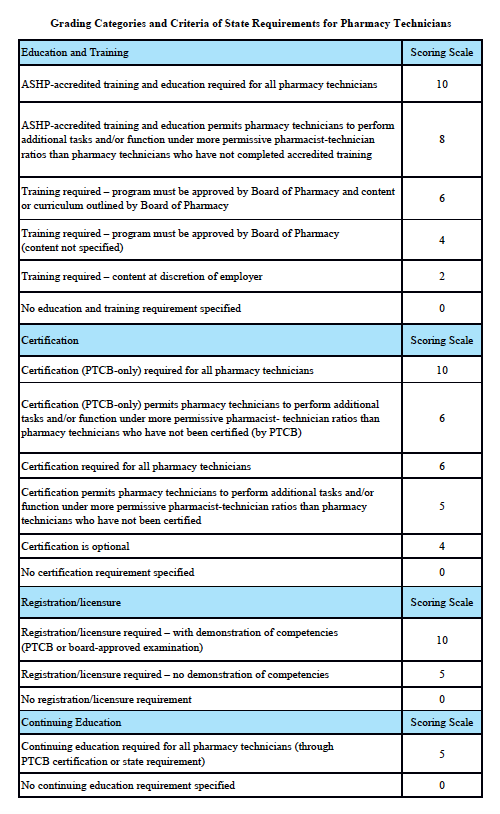
Scoring rationale for Education and Training: In order to protect the public and help ensure patient safety, it is important that pharmacy technicians are properly educated and trained. The most rigorous training is accredited training. The sole entity empowered to accredit pharmacy-technician training programs is the American Society of Health-System Pharmacists (ASHP). Please note that this is “programmatic accreditation” – not “institutional accreditation.” It is the content of the training program – as measured against established standards – that is being evaluated and accredited. Accredited training is vital to protecting patient safety because it means that a pharmacy-technician training program has met established quality standards to provide assurance and confidence to the public. For more information, please see http://www.ashp.org/menu/Accreditation/TechnicianAccreditation.aspx.
Scoring rationale for Certification: Certification is the process by which a nongovernmental agency or association grants recognition to an individual who has met certain predetermined qualifications specified by that agency or association. This is often determined by an examination process. Numerous organizations have recommended that the certification exam conducted by the Pharmacy Technician Certification Board (PTCB) should be recognized as the sole, nationally-accredited certification exam for pharmacy technician certification – including the National Association of Boards of Pharmacy (NABP), the Texas State Board of Pharmacy (TSBP), and the U.S. Department of Veterans Affairs (VA). In a recent report, NABP recommended that states be encouraged to “recognize certification by the Pharmacy Technician Certification Board (PTCB).” Moreover, NABP performed a psychometric audit of the PTCB’s pharmacy technician certification examination (PTCE) in 2001 and determined that the PTCE is psychometrically sound, defensible, and valid. In May 2010, the TSBP awarded the PTCB with the Pharmacy Technician Certification Provider contract in Texas. PTCB was selected for the contract after a rigorous bidding and evaluation process that included formal reviews and evaluations from three independent psychometricians. TSBP confidently recognizes PTCB as the single provider of certification examinations for pharmacy technicians. In addition, in June 2010, the VA began requiring PTCB certification for VA pharmacy technicians employed at grade GS-6 and above.
Scoring rationale for Registration/Licensure: Registration/licensure is the process by which the state maintains a list of all pharmacy technicians in the state and grants permission for an individual to work as a pharmacy technician in the state based on the applicant’s completion of all pre-requisites to registration/licensure – such as required training and certification.
Scoring rationale for Continuing Education: Continuing education enables pharmacy technicians to fulfill their professional responsibility to maintain competence and up-to-date knowledge and skills in an environment of technological advances and increasingly complex, new medications and therapies.
Our Mission
The Emily Jerry Foundation is determined to help make our nation’s,
world renowned, medical facilities safer for everyone, beginning with
our babies and children. We are accomplishing this very important
objective by focusing on increasing public awareness of key patient
safety related issues and identifying technology and best practices that
are proven to minimize the “human error” component of medicine.
Through our ongoing efforts The Emily Jerry Foundation is working
hard to save lives every day.




Kansas Scorecard
Grading Scale:
A – 85-100%, B – 70-84.9%, C – 55-69.9%, D – 40-54.9%, F – 0-39.9%
Grading Categories & Criteria
Kansas Law
Kansas Pharmacy Statutes and Regulations:
https://www.pharmacy.ks.gov/legal/statutes-regs
65-1626. Definitions.
(ccc) “Pharmacy technician” means an individual who, under the direct supervision and control of
a pharmacist, may perform packaging, manipulative, repetitive or other nondiscretionary tasks related
to the processing of a prescription or medication order and who assists the pharmacist in the
performance of pharmacy-related duties, but who does not perform duties restricted to a pharmacist.” “No change.
65-1663. Registration of pharmacy technicians; applications; registration fee; qualifications for registration; expiration and renewal of registration; grounds for denial of application or registration; revocation, suspension or limitation of registration; responsibilities of pharmacists and pharmacies; rules and regulations.
(a) It shall be unlawful for any person to function as a pharmacy technician in this state unless such person is registered with the board as a pharmacy technician. Every person registered as a
pharmacy technician shall have graduated from an accredited high school or its equivalent, obtained a graduate equivalent diploma (GED) or be enrolled and in good standing in a high school education program. Every person registered as a pharmacy technician shall pass one or more examinations identified and approved by the board within the period or periods of time specified by the board after becoming registered. The board shall adopt rules and regulations
identifying the required examinations, when they must be passed and establishing the criteria for the required examinations and passing scores. The board may include as a required examination any national pharmacy technician certification examination. The board shall adopt rules and regulations restricting the tasks a pharmacy technician may perform prior to passing any required examinations.
(b) All applications for registration shall be made on a form to be prescribed and furnished by the board. Each application for registration shall be accompanied by a registration fee fixed by the
board by rule and regulation not to exceed $50.
(c) The board shall take into consideration any felony conviction of an applicant, but such conviction shall not automatically operate as a bar to registration.
(d) Except as otherwise provided in this subsection, each pharmacy technician registration issued by the board shall expire every two years. The expiration date shall be established by rules and regulations adopted by the board. To provide for a system of biennial renewal of pharmacy technician registrations, the board may provide by rules and regulations that registrations issued or renewed may expire less than two years from the date of issuance or renewal. Each applicant for renewal of a pharmacy technician registration shall be made on a form prescribed and furnished by the board and shall be accompanied by a renewal fee fixed by the board by rule and regulation not to exceed $25. Pharmacy technician registration renewal fees may be prorated for registration periods which are less than biennial in accordance with rules and regulations of the board. Except as otherwise provided in this subsection, the application for registration renewal, when accompanied by the renewal fee and evidence satisfactory to the board that the person has successfully complied with the rules and regulations of the board establishing the requirements for a program of continuing pharmacy technician education and received by the secretary on or before the date of expiration of the registration, shall have the effect of temporarily renewing the applicant’s registration until actual issuance or denial of the renewal registration. If at the time of filing a proceeding is pending before the board which may result in the suspension, probation, revocation or denial of the applicant’s registration, the board may by emergency order declare that the application for renewal shall not have the effect of temporarily renewing such applicant’s registration. If the renewal fee is not paid prior to the expiration date of the renewal year, the registration is void.
(e) Continuing pharmacy technician education requirements shall be fixed by the board at not more than 20 clock hours biennially of a program of continuing education approved by the board. Continuing education hours may be prorated for licensure periods that are less than biennial in accordance with rules and regulations of the board.
(f) (1) The board may limit, suspend or revoke a registration or deny an application for issuance or renewal of any registration as a pharmacy technician on any ground, which would authorize the board to take action against the license of a pharmacist under K.S.A. 65-1627, and amendments thereto.
(2) The board may require a physical or mental examination, or both, of a person applying for or registered as a pharmacy technician.
(3) The board may temporarily suspend or temporarily limit the registration of any pharmacy technician in accordance with the emergency adjudicative proceedings under the Kansas administrative procedure act if the board determines that there is cause to believe that grounds exist for disciplinary action under this section against the registrant and that the registrant’s continuation of pharmacy technician functions would constitute an imminent
danger to the public health and safety.
(4) Proceedings under this section shall be subject to the Kansas administrative procedure act.
(g) Every registered pharmacy technician, within 30 days of obtaining new employment or ceasing employment as a pharmacy technician, shall notify the secretary of the name and address of the new employer or cessation of employment.
(h) Every pharmacy technician who changes their residential address, email address or legal name shall, within 30 days thereof, notify the secretary of such change on a form prescribed and
furnished by the board.
(i) Each pharmacy shall at all times maintain a list of the names of pharmacy technicians employed by the pharmacy. A pharmacy technician shall work under the direct supervision and control of a pharmacist, and while on duty, shall wear a name badge or similar identification with the pharmacy technician’s name and designation as a pharmacy technician. It shall be the responsibility of the supervising pharmacist to determine that the pharmacy technician is in compliance with the applicable rules and regulations of the board, and the supervising pharmacist shall be responsible for the acts and omissions of the pharmacy technician in the performance of the pharmacy technician’s duties. The ratio of pharmacy technicians to
pharmacists in the prescription area of a pharmacy shall be prescribed by the board by rule and regulation. Any change in the ratio of pharmacy technicians to pharmacists in the prescription
area of the pharmacy must be adopted by a vote of no less than six members of the board.
(j) Every registered pharmacy technician shall display the current registration in that part of the place of business in which such person is engaged in pharmacy technician activities.
(k) Every pharmacy technician registered after July 1, 2017, shall be required to pass a certified pharmacy technician examination approved by the board.
(l) The board shall adopt such rules and regulations as are necessary to ensure that pharmacy technicians are adequately trained as to the nature and scope of their lawful duties.
(m) The board may adopt rules and regulations as may be necessary to carry out the purposes and enforce the provisions of this act.
(n) This section shall be part of and supplemental to the pharmacy act of the state of Kansas.” “No change.
68-5-15 Training of pharmacy technicians.
(a) The pharmacist-in-charge of any pharmacy in which one or more pharmacy technicians perform any tasks authorized by the pharmacy act shall insure that each pharmacy technician complies with the training requirements in this regulation.
(b) The pharmacist-in-charge of any pharmacy in which one or more pharmacy technicians perform any tasks authorized by the pharmacy act shall insure that there exists for the pharmacy a current pharmacy technician training course, designed for the functioning of that pharmacy and addressing at least the following:
(1) Knowledge and understanding of the different pharmacy practice settings;
(2) knowledge and understanding of the duties and responsibilities of a pharmacy technician in relationship to other pharmacy personnel and knowledge of standards, ethics, laws, and regulations governing the practice of pharmacy;
(3) knowledge and ability to identify and employ pharmaceutical and medical terms, abbreviations, and symbols commonly used in prescribing and dispensing drugs and in record keeping;
(4) knowledge of and the ability to carry out calculations required for common dosage determinations;
(5) knowledge and understanding of the identification of drugs, drug dosages, routes of administration, dosage forms, storage requirements, and manufacturer recalls;
(6) knowledge of and the ability to perform the manipulative and record-keeping functions involved in and related to dispensing prescriptions or other drug distribution systems; and
(7) knowledge of and the ability to perform procedures and techniques, including aseptic techniques, relating to the compounding, packaging, and labeling of drugs.
(c) The pharmacist-in-charge of any pharmacy shall permit a pharmacy technician to perform tasks authorized by the pharmacy act only if the pharmacy technician has successfully completed, within 180 days of the effective date of this regulation or the effective date of the technician’s employment in the pharmacy, whichever is later, a training course that meets the requirements of subsection (b) and was designed for the pharmacy in which the tasks are performed.
(d) The pharmacist-in-charge of any pharmacy in which one or more pharmacy technicians perform any tasks authorized by the pharmacy act shall also insure that the following requirements are met:
(1) There is an annual review of the pharmacy technician training course developed for the pharmacy.
(2) Adequate records are maintained documenting the training of each pharmacy technician as required by this regulation. These records shall be maintained at the pharmacy in a manner
available for inspection by a board representative.
(3) The board is notified, within 30 days of the effective date of this regulation or the effective date of the employment of a pharmacy technician, of the following:
(i) The full name and current residence address of pharmacy technicians working in a pharmacy for which the pharmacist-in-charge has responsibility;
(ii) the date on which the pharmacy technician began the pharmacy technician training course or courses designed for the pharmacy or pharmacies in which the pharmacy technician is working; and
(iii) the name and address of the pharmacy or pharmacies in which the pharmacy technician is working.
(Authorized by K.S.A. 65-1630 and K.S.A. 1998 Supp. 65-1642; implementing K.S.A. 1998 Supp. 65-1642; effective July 23, 1999.)” “68-5-16 Ratio of pharmacy technicians to pharmacists.
The ratio of pharmacy technicians to pharmacists in any pharmacy shall not exceed four to one.
A pharmacist shall not supervise at any time more than two pharmacy technicians who have not passed a certification examination approved by the board pursuant to K.A.R. 68-5-17.
(Authorized by and implementing K.S.A. 65-1663; effective, T-68-8-22-05, Aug. 22, 2005; effective May 26, 2006; amended April 27, 2007; amended February 7, 2020.)
68-5-17. Pharmacy technicians; certification examination; request for extension.
The following requirements shall apply to each individual who applies for a new pharmacy technician registration on or after July 1, 2017:
(a) Each pharmacy technician shall be required to pass either the pharmacy technician certification board (PTCB) certification examination or the national healthcareer association (NHA) ExCPT certification examination before the first renewal of the pharmacy technician’s registration.
(1) Each pharmacy technician shall be required to attain a scaled score of at least 1400 on the PTCB certification examination in order to pass.
(2) Each pharmacy technician shall be required to attain a score of at least 390 on the NHA ExCPT certification examination in order to pass.
(b) Any pharmacy technician who is unable to take or pass an approved certification examination before the first renewal of the pharmacy technician’s registration may submit to the board, on a form provided by the board, a request for a six-month extension to pass an approved certification examination. The request shall be submitted to the board at least 30 days before the pharmacy technician’s registration expiration date and shall provide the reason for the request, which may include any of the following:
(1) Previous examination attempts and failures;
(2) the commencement date of training or preparation and the reasons for delay;
(3) an event that directly resulted from the occurrence of natural causes outside the pharmacy technician’s control;
(4) a change in employment and the relevant dates; or
(5) medical necessity.
(c) Within 30 days after passing an approved certification examination or before the first renewal, whichever is earlier, each pharmacy technician shall submit to the board proof of successful completion of the examination.
(Authorized by K.S.A. 2016 Supp. 65-1663, as amended by L. 2017, ch. 34, sec. 15, and K.S.A. 2016 Supp. 65-1692; implementing K.S.A. 2016 Supp. 65-1663, as amended by L. 2017, ch. 34, sec. 15; effective May 11, 2018.)
68-5-18. Pharmacy technicians; continuing education.
(a)(1) ‘‘Continuing education’’ shall mean an organized and systematic education experience beyond basic preparation that is designed to achieve the following:
(A)(i) Increase knowledge, improve skills, or enhance the practice of pharmacy; or
(ii) improve protection of the public health and welfare; and
(B) ensure continued competence.
(2) “ACPE-NABP CPE monitor service” shall mean the electronic tracking service of the accreditation council for pharmacy education and the national association of boards of pharmacy for monitoring continuing education that pharmacy technicians receive from
continuing education providers.
(b) Twenty clock-hours of continuing education shall be required for renewal of a pharmacy technician registration during each registration period. Continuing education clock-hours may be
prorated for registration periods that are less than biennial at a rate of 0.8 clock-hours per month.
(c)(1) Each continuing education program shall be approved by the board. Each provider or registrant shall submit the continuing education program to the board at least 10 days in advance
for consideration for approval. Each provider shall advertise the continuing education program as having only pending approval until the provider is notified of approval by the board.
(2) Continuing education programs shall not include in-service programs, on-the-job training, orientation for a job, an education program open to the general public, a cardiopulmonary resuscitation (CPR) course, a basic cardiac life support (BCLS) course, emergency or disaster training or direct experience at a healthcare facility under a code blue, testing out of a course, and medical school courses.
(3) Each provider shall furnish a certificate of completion to the pharmacy technician for each continuing education program that the registrant has successfully completed. Each certificate shall be in a format approved by the board and shall include the following:
(A) The registrant’s name;
(B) the title and date of the approved continuing education program;
(C) the name of the provider;
(D) the number of continuing education clock-hours approved by the board;
(E) the number of continuing education clock-hours completed by the registrant;
(F) the approved program number issued by the board; and
(G) the provider’s dated signature, certifying program completion.
(d) Within 30 days of completion, each pharmacy technician shall submit to the board proof of completion of any approved continuing education program not reported to the ACPE-NABP CPE monitor service. No credit shall be given for any certificate of completion received by the board after the October 31 expiration date of each registration period.
(e) A licensee shall not be allowed to carry forward excess clock-hours earned in one registration period into the next registration period.
(f) The required continuing education shall be obtained in the two-year registration period ending on the October 31 expiration date of each registration.
(Authorized by K.S.A. 65-1630 and K.S.A. 2015 Supp. 65-1663; implementing K.S.A. 2015 Supp. 65-1663; effective Aug. 19, 2016.)”
The data contained in this 2012 Annual Scorecard are accurate as of December 2012 . Because statutes and regulations are continually revised, the data are subject to change. These data have been verified with the state board of pharmacy. This scorecard is updated on an annual basis in order to incorporate statutory and regulatory changes. A new scorecard will be issued in July 2013.
Scoring rationale for Education and Training:
In order to protect the public and help ensure patient safety, it is important that pharmacy technicians are properly educated and trained. The most rigorous training is accredited training. The sole entity empowered to accredit pharmacy-technician training programs is the American Society of Health-System Pharmacists (ASHP). Please note that this is “programmatic accreditation” – not “institutional accreditation.” It is the content of the training program – as measured against established standards – that is being evaluated and accredited. Accredited training is vital to protecting patient safety because it means that a pharmacy-technician training program has met established quality standards to provide assurance and confidence to the public. For more information, please see http://www.ashp.org/menu/Accreditation/TechnicianAccreditation.aspx.
Scoring rationale for Certification:
Certification is the process by which a nongovernmental agency or association grants recognition to an individual who has met certain predetermined qualifications specified by that agency or association. This is often determined by an examination process. Numerous organizations have recommended that the certification exam conducted by the Pharmacy Technician Certification Board (PTCB) should be recognized as the sole, nationally-accredited certification exam for pharmacy technician certification – including the National Association of Boards of Pharmacy (NABP), the Texas State Board of Pharmacy (TSBP), and the U.S. Department of Veterans Affairs (VA). In a recent report, NABP recommended that states be encouraged to “recognize certification by the Pharmacy Technician Certification Board (PTCB).” Moreover, NABP performed a psychometric audit of the PTCB’s pharmacy technician certification examination (PTCE) in 2001 and determined that the PTCE is psychometrically sound, defensible, and valid. In May 2010, the TSBP awarded the PTCB with the Pharmacy Technician Certification Provider contract in Texas. PTCB was selected for the contract after a rigorous bidding and evaluation process that included formal reviews and evaluations from three independent psychometricians. TSBP confidently recognizes PTCB as the single provider of certification examinations for pharmacy technicians. In addition, in June 2010, the VA began requiring PTCB certification for VA pharmacy technicians employed at grade GS-6 and above.
Scoring rationale for Registration/Licensure:
Registration/licensure is the process by which the state maintains a list of all pharmacy technicians in the state and grants permission for an individual to work as a pharmacy technician in the state based on the applicant’s completion of all pre-requisites to registration/licensure – such as required training and certification.
Scoring rationale for Continuing Education:
Continuing education enables pharmacy technicians to fulfill their professional responsibility to maintain competence and up-to-date knowledge and skills in an environment of technological advances and increasingly complex, new medications and therapies.
Our Mission
The Emily Jerry Foundation is determined to help make our nation’s, world renowned, medical facilities safer for everyone, beginning with our babies and children. We are accomplishing this very important objective by focusing on increasing public awareness of key patient safety related issues and identifying technology and best practices that are proven to minimize the “human error” component of medicine. Through our ongoing efforts The Emily Jerry Foundation is working hard to save lives every day.
Recent Posts
Archives