(38) “Pharmacy technician” means an individual who is specifically trained and designated to assist a pharmacist and may perform tasks delegated by the pharmacist, including participation in drug, dietary supplement and device selection, storage, and distribution and administration, consistent with the pharmacy technician’s education, training, and experience, as defined by rules promulgated by the board;” “63-10-304 is now 63-10-308. Enforcement of pharmaceutical laws – Promulgation of rules
(d) (1) The board shall: (A) Keep a record of the board’s meetings and other proceedings; (B) Issue and maintain a register of all persons who have been issued licenses and who have had their licenses renewed; and (C) Maintain a register of pharmacists who have been designated as a pharmacist-in-charge. (2) The board may maintain a register of pharmacy technicians as necessary to maintain public welfare.” “63-10-306 is now 63-10-310. License requirements.
(f) (1) The board may license and register pharmacists, pharmacies, wholesalers, distributors, pharmacy technicians, pharmacy interns, manufacturers, third-party logistics providers, and other persons as may be required under federal or state law. This subdivision (f)(1) does not include manufacturers’ representatives unless otherwise required by federal or state law.
(g) (1) The board may promulgate rules to: (A) Establish the criteria, timing and procedure for the renewal of licenses; (B) Establish the requirements for continuing education for persons the board licenses or to whom the board issues certificates. This authority includes, but is not limited to, the establishment of the number of continuing education hours required, approval of providers and course content, enforcement of continuing education requirements, and qualification for waiver of the requirements or extension of time in which to obtain the continuing education; and (C) Designate which national or other qualified pharmacy technician certification agencies are recognized in this state for maintaining certification as a pharmacy technician. (2) The board shall promulgate rules to define the scope of practice of pharmacy technicians and the qualifications necessary to practice as a pharmacy technician.
(8) “Certified pharmacy technician” means an individual who is certified by a national or state agency that offers a certification program that is recognized by the board.” “1140-01-.09 RENEWAL OF LICENSES. (1) All licenses and certificates of registration granted by the board shall be for a two (2) year period beginning on the date the license is initially granted. All licenses and certificates of registration shall be renewed on or before the last day of the two (2) year license cycle. (2) A pharmacist or pharmacy technician serving in the uniformed services of the United States shall not be required to pay license or registration renewal fees during the period of active duty and the pharmacist shall not be required to complete continuing pharmacy education requirements during the period of active duty. (3) Prior to renewal of its license in this state, an out-of-state pharmacy practice site engaged in compounding must provide to the Board the most recent inspection by the regulatory or licensing agency of the state in which the pharmacy practice site is physically located, an inspection performed by the United States Food and Drug Administration, or an inspection performed by the National Association of Boards of Pharmacy, that must have been within the previous twelve (12) months. (4) Upon request, the Board may waive selected portions of these requirements so long as any waiver granted is consistent with the Board’s authority under Tenn. Code Ann. Title 63, Chapters 1 and 10, and Tenn. Code Ann. Title 4, Chapter 5.
The data contained in this 2012 Annual Scorecard are accurate as of December 2012 . Because statutes and regulations are continually revised, the data are subject to change. These data have been verified with the state board of pharmacy. This scorecard is updated on an annual basis in order to incorporate statutory and regulatory changes. A new scorecard will be issued in July 2013.
Scoring rationale for Education and Training: In order to protect the public and help ensure patient safety, it is important that pharmacy technicians are properly educated and trained. The most rigorous training is accredited training. The sole entity empowered to accredit pharmacy-technician training programs is the American Society of Health-System Pharmacists (ASHP). Please note that this is “programmatic accreditation” – not “institutional accreditation.” It is the content of the training program – as measured against established standards – that is being evaluated and accredited. Accredited training is vital to protecting patient safety because it means that a pharmacy-technician training program has met established quality standards to provide assurance and confidence to the public. For more information, please see http://www.ashp.org/menu/Accreditation/TechnicianAccreditation.aspx.
Scoring rationale for Certification: Certification is the process by which a nongovernmental agency or association grants recognition to an individual who has met certain predetermined qualifications specified by that agency or association. This is often determined by an examination process. Numerous organizations have recommended that the certification exam conducted by the Pharmacy Technician Certification Board (PTCB) should be recognized as the sole, nationally-accredited certification exam for pharmacy technician certification – including the National Association of Boards of Pharmacy (NABP), the Texas State Board of Pharmacy (TSBP), and the U.S. Department of Veterans Affairs (VA). In a recent report, NABP recommended that states be encouraged to “recognize certification by the Pharmacy Technician Certification Board (PTCB).” Moreover, NABP performed a psychometric audit of the PTCB’s pharmacy technician certification examination (PTCE) in 2001 and determined that the PTCE is psychometrically sound, defensible, and valid. In May 2010, the TSBP awarded the PTCB with the Pharmacy Technician Certification Provider contract in Texas. PTCB was selected for the contract after a rigorous bidding and evaluation process that included formal reviews and evaluations from three independent psychometricians. TSBP confidently recognizes PTCB as the single provider of certification examinations for pharmacy technicians. In addition, in June 2010, the VA began requiring PTCB certification for VA pharmacy technicians employed at grade GS-6 and above.
Scoring rationale for Registration/Licensure: Registration/licensure is the process by which the state maintains a list of all pharmacy technicians in the state and grants permission for an individual to work as a pharmacy technician in the state based on the applicant’s completion of all pre-requisites to registration/licensure – such as required training and certification.
Scoring rationale for Continuing Education: Continuing education enables pharmacy technicians to fulfill their professional responsibility to maintain competence and up-to-date knowledge and skills in an environment of technological advances and increasingly complex, new medications and therapies.
Our Mission
The Emily Jerry Foundation is determined to help make our nation’s,
world renowned, medical facilities safer for everyone, beginning with
our babies and children. We are accomplishing this very important
objective by focusing on increasing public awareness of key patient
safety related issues and identifying technology and best practices that
are proven to minimize the “human error” component of medicine.
Through our ongoing efforts The Emily Jerry Foundation is working
hard to save lives every day.
Tomorrow, I’m really looking forward to heading to Monterey, California to speak on behalf of the Emily Jerry Foundation at the Pacific Coast Patient Safety Conference, hosted by the California Society of Health – System Pharmacists. But today… Read More
The week before last truly meant a great deal to me. I was honored to be invited back to Touro College of Pharmacy to deliver another Dean’s Hour lecture, after having the privilege of speaking there last April…. Read More
I’m really looking forward to heading to New York City this morning for two very meaningful speaking engagements at Touro University’s College of Pharmacy. This journey began with an invitation to deliver a CE presentation at the NYCSHP… Read More

Tennessee Scorecard
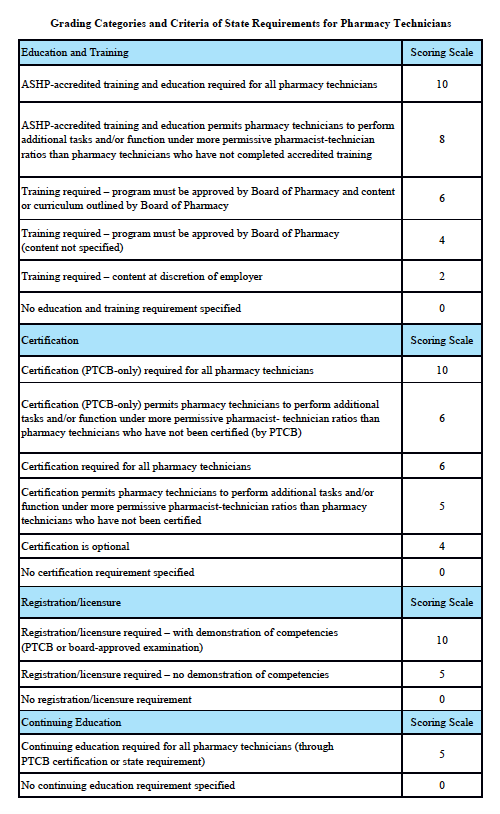
Grading Scale:
A – 85-100%, B – 70-84.9%, C – 55-69.9%, D – 40-54.9%, F – 0-39.9%
Grading Categories & Criteria
Tennessee Law
I. Laws
TENNESSEE CODE UNANNOTATED
http://www.lexisnexis.com/hottopics/tncode/
63-10-204. Definitions.
(38) “Pharmacy technician” means an individual who is specifically trained and designated to assist a pharmacist and may perform tasks delegated by the pharmacist, including participation in drug, dietary supplement and device selection, storage, and distribution and administration, consistent with the pharmacy technician’s education, training, and experience, as defined by rules promulgated by the board;” “63-10-304 is now 63-10-308. Enforcement of pharmaceutical laws – Promulgation of rules
(d)
(1) The board shall:
(A) Keep a record of the board’s meetings and other proceedings;
(B) Issue and maintain a register of all persons who have been issued licenses and who have had their licenses renewed; and
(C) Maintain a register of pharmacists who have been designated as a pharmacist-in-charge.
(2) The board may maintain a register of pharmacy technicians as necessary to maintain public welfare.” “63-10-306 is now 63-10-310. License requirements.
(f)
(1) The board may license and register pharmacists, pharmacies, wholesalers, distributors, pharmacy technicians, pharmacy interns, manufacturers, third-party logistics providers, and other persons as may be required under federal or state law. This subdivision (f)(1) does not include manufacturers’ representatives unless otherwise required by federal or state law.
(g)
(1) The board may promulgate rules to:
(A) Establish the criteria, timing and procedure for the renewal of licenses;
(B) Establish the requirements for continuing education for persons the board licenses or to whom the board issues certificates. This authority includes, but is not limited to, the establishment of the number of continuing education hours required, approval of providers and course content, enforcement of continuing education requirements, and qualification for waiver of the requirements or extension of time in which to obtain the continuing education; and
(C) Designate which national or other qualified pharmacy technician certification agencies are recognized in this state for maintaining certification as a pharmacy technician.
(2) The board shall promulgate rules to define the scope of practice of pharmacy technicians and the qualifications necessary to practice as a pharmacy technician.
Tennessee Rules and Regulations
https://sos.tn.gov/publications/services/effective-rules-and-regulations-of-the-state-of-tennessee
1140-01-.01 Definitions -NO CHANGE-
(8) “Certified pharmacy technician” means an individual who is certified by a national or state agency that offers a certification program that is recognized by the board.” “1140-01-.09 RENEWAL OF LICENSES.
(1) All licenses and certificates of registration granted by the board shall be for a two (2) year period beginning on the date the license is initially granted. All licenses and certificates of registration shall be renewed on or before the last day of the two (2) year license cycle.
(2) A pharmacist or pharmacy technician serving in the uniformed services of the United States shall not be required to pay license or registration renewal fees during the period of active duty and the pharmacist shall not be required to complete continuing pharmacy education requirements during the period of active duty.
(3) Prior to renewal of its license in this state, an out-of-state pharmacy practice site engaged in compounding must provide to the Board the most recent inspection by the regulatory or licensing agency of the state in which the pharmacy practice site is physically located, an inspection performed by the United States Food and Drug Administration, or an inspection performed by the National Association of Boards of Pharmacy, that must have been within
the previous twelve (12) months.
(4) Upon request, the Board may waive selected portions of these requirements so long as any waiver granted is consistent with the Board’s authority under Tenn. Code Ann. Title 63, Chapters 1 and 10, and Tenn. Code Ann. Title 4, Chapter 5.
The data contained in this 2012 Annual Scorecard are accurate as of December 2012 . Because statutes and regulations are continually revised, the data are subject to change. These data have been verified with the state board of pharmacy. This scorecard is updated on an annual basis in order to incorporate statutory and regulatory changes. A new scorecard will be issued in July 2013.
Scoring rationale for Education and Training:
In order to protect the public and help ensure patient safety, it is important that pharmacy technicians are properly educated and trained. The most rigorous training is accredited training. The sole entity empowered to accredit pharmacy-technician training programs is the American Society of Health-System Pharmacists (ASHP). Please note that this is “programmatic accreditation” – not “institutional accreditation.” It is the content of the training program – as measured against established standards – that is being evaluated and accredited. Accredited training is vital to protecting patient safety because it means that a pharmacy-technician training program has met established quality standards to provide assurance and confidence to the public. For more information, please see http://www.ashp.org/menu/Accreditation/TechnicianAccreditation.aspx.
Scoring rationale for Certification:
Certification is the process by which a nongovernmental agency or association grants recognition to an individual who has met certain predetermined qualifications specified by that agency or association. This is often determined by an examination process. Numerous organizations have recommended that the certification exam conducted by the Pharmacy Technician Certification Board (PTCB) should be recognized as the sole, nationally-accredited certification exam for pharmacy technician certification – including the National Association of Boards of Pharmacy (NABP), the Texas State Board of Pharmacy (TSBP), and the U.S. Department of Veterans Affairs (VA). In a recent report, NABP recommended that states be encouraged to “recognize certification by the Pharmacy Technician Certification Board (PTCB).” Moreover, NABP performed a psychometric audit of the PTCB’s pharmacy technician certification examination (PTCE) in 2001 and determined that the PTCE is psychometrically sound, defensible, and valid. In May 2010, the TSBP awarded the PTCB with the Pharmacy Technician Certification Provider contract in Texas. PTCB was selected for the contract after a rigorous bidding and evaluation process that included formal reviews and evaluations from three independent psychometricians. TSBP confidently recognizes PTCB as the single provider of certification examinations for pharmacy technicians. In addition, in June 2010, the VA began requiring PTCB certification for VA pharmacy technicians employed at grade GS-6 and above.
Scoring rationale for Registration/Licensure:
Registration/licensure is the process by which the state maintains a list of all pharmacy technicians in the state and grants permission for an individual to work as a pharmacy technician in the state based on the applicant’s completion of all pre-requisites to registration/licensure – such as required training and certification.
Scoring rationale for Continuing Education:
Continuing education enables pharmacy technicians to fulfill their professional responsibility to maintain competence and up-to-date knowledge and skills in an environment of technological advances and increasingly complex, new medications and therapies.
Our Mission
The Emily Jerry Foundation is determined to help make our nation’s, world renowned, medical facilities safer for everyone, beginning with our babies and children. We are accomplishing this very important objective by focusing on increasing public awareness of key patient safety related issues and identifying technology and best practices that are proven to minimize the “human error” component of medicine. Through our ongoing efforts The Emily Jerry Foundation is working hard to save lives every day.
Recent Posts
Archives
Recent News
Happy Heavenly 22nd Birthday Emily + Upcoming Pacific Coast Patient Safety Conference
February 24, 2026
By ejfadmin
Tomorrow, I’m really looking forward to heading to Monterey, California to speak on behalf of the Emily Jerry Foundation at the Pacific Coast Patient Safety Conference, hosted by the California Society of Health – System Pharmacists. But today… Read More
Dean’s Hour Recap at Touro College of Pharmacy
February 9, 2026
By ejfadmin
The week before last truly meant a great deal to me. I was honored to be invited back to Touro College of Pharmacy to deliver another Dean’s Hour lecture, after having the privilege of speaking there last April…. Read More
Speaking Engagements at Touro University’s College of Pharmacy Hosted by the NYC Chapter of the New York State Council of Health-System Pharmacists
January 23, 2026
By ejfadmin
I’m really looking forward to heading to New York City this morning for two very meaningful speaking engagements at Touro University’s College of Pharmacy. This journey began with an invitation to deliver a CE presentation at the NYCSHP… Read More